

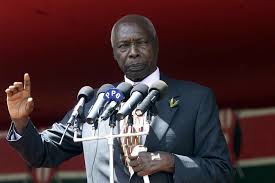
Kenya's Daniel T. arap Moi vs. other reigns in the world:
Daniel Toroitich Kapkorios arap Moi (Daniel T. arap Moi) was Kenya's President from 22nd August 1978 to 30th December 2002. Opinion in Kenya remains divided on Daniel Toroitich Kapkorios arap Moi (Daniel T. arap Moi) and his legacy, and "Uncle Dan" (one of his nicknames) remains loved and hated in equal measure in Kenya. There are indeed those who regard "Uncle Dan" as having been a despot and brutal dictator.
But was he really?
He was not an angel, but was he really the despot and brutal dictator that he continues to be portrayed as having been? Was Kenya a round-the-clock World War II type "Concentration Camp" during his 24 year presidency?
At a glance, Jomo Kenyatta's premiership and presidency was even more brutal than the Daniel T. arap Moi presidency i.e. Jomo Kenyatta was Prime Minister and President of Kenya for a total of 15 years, two months and 21 days i.e. from 1st June 1963 to 22nd August 1978, while Daniel T. arap Moi was President of Kenya for 24 years, four months and 8 days i.e. as mentioned, from 22nd August 1978 to 30th December 2002.
In Jomo Kenyatta's 15 years, two months and 21 days there were three high profile assassinations that remain unresolved to this day i.e. those of Pio Gama Pinto in 1965, Thomas Joseph Mboya in 1969 and Josiah Mwangi Kariuki in 1975, and in Daniel T. arap Moi's 24 years, four months and 8 days, there was one high profile assassination that remains unresolved to this day i.e. that of Dr. Robert John Ouko in 1990.
The question, in an overall sense, remains whether Daniel T. arap Moi's 24 year presidency was as despotic and as brutal as continues to be portrayed as having been.
One way of determining this would be to look at what are regarded as despotic and brutal reigns in history, a number of which are listed below, courtesy of citations at Wikipedia:
1. McCarthyism was a vociferous campaign against alleged Communists in the American Government and other institutions, and was carried out under Senator Joseph McCarthy in the period 1950 to 1954. Many of the accused were blacklisted or lost their jobs, though most did not in fact belong to the Communist Party.
Following what is referred as "The First Red Scare," President Harry S. Truman signed an executive order in 1947 to screen federal employees for association with organisations deemed "Totalitarian, Fascist, Communist or subversive," or advocating "to alter the form of Government of the United States by unconstitutional means.
During the McCarthy era, hundreds of Americans were accused of being "Communists" or "Communist sympathisers." They became the subject of aggressive investigations and questioning before government or private industry panels, committees, and agencies. The primary targets of such suspicions were government employees, those in the entertainment industry, academics, and labour-union activists. Suspicions were often given credence despite inconclusive or questionable evidence, and the level of threat posed by a person's real or supposed leftist associations or beliefs were sometimes exaggerated. Many people suffered loss of employment or destruction of their careers; some were imprisoned.
Estimating the number of victims of McCarthy is difficult. The number imprisoned is in the hundreds, and some ten or twelve thousand lost their jobs.
Homosexuality was classified as a psychiatric disorder in the 1950s. However, in the context of the highly politicised Cold War environment, homosexuality became framed as a dangerous, contagious social disease that posed a potential threat to State Security.
In the film industry, more than 300 actors, authors, and directors were denied work in America through the unofficial Hollywood blacklist. Blacklists were at work throughout the entertainment industry, in universities and schools at all levels, in the legal profession, and in many other fields.
Some of the notable people who were blacklisted or suffered some other persecution during McCarthyism include:
1. Charlie Chaplin, actor and director;
2. W.E.B. Du Bois, civil rights activist and author;
3. Albert Einstein, Nobel Prize-winning physicist, philosopher, mathematician, activist;
4. George A. Eddy, pre-Keynesian Harvard economist, US Treasury monetary policy specialist;
5. John Garfield, actor;
6. Lena Horne, singer;
7. Gypsy Rose Lee, actress and stripper;
8. Thomas Mann, Nobel Prize winning novelist and essayist;
9. Dorothy Parker, writer, humorist;
10. Artie Shaw, jazz musician, bandleader, author;
11. Orson Welles, actor, author, film director;
Julius and Ethel Rosenberg were American citizens who were convicted of spying on behalf of the Soviet Union. The couple was accused of providing top-secret information about radar, sonar, jet propulsion engines and valuable nuclear weapon designs.
At that time the United States was the only country in the world with nuclear weapons.
Convicted of espionage in 1951, they were executed by the Federal Government of the United States in 1953 in the Sing Sing correctional facility in Ossining, New York, becoming the first American civilians to be executed for such charges and the first to suffer that penalty during peacetime.
2. Col. Mengistu Haile Mariam, born 21st May 1937, is an Ethiopian soldier and politician who was President of Ethiopia from 1977 to 1991 and General Secretary of the Workers' Party of Ethiopia from 1984 to 1991.
He was the Chairman of the Derg, the Socialist Military Junta that governed Ethiopia, from 1977 to 1987, and the President of the People's Democratic Republic of Ethiopia (PDRE) from 1987 to 1991.
He is considered to be one of the most notorious African leaders of the 20th century, and his reign is infamous for its brutality, autocracy and economic mismanagement.
His bloody consolidation of power in 1977 and 1978 is known as the Ethiopian Red Terror, a brutal crackdown on opposition groups and civilians following a failed assassination attempt by the Ethiopian People's Revolutionary Party (EPRP) in September 1976, after it had ignored the Derg's invitation to join the Union of Socialist Parties.
Mengistu's government is estimated to be responsible for the deaths of 500,000 to 2,000,000 Ethiopians.
3. The Cambodian Genocide was the systematic persecution and killing of Cambodians by the Khmer Rouge under the leadership of Communist Party General Secretary Pol Pot, who radically pushed Cambodia towards Communism.
Deaths: 1.5 to 2 million
Dates: 17th April 1975 – 7th January 1979
Perpetrator: Khmer Rouge
Location: Democratic Kampuchea
Attack types: Genocide, Torture, Famine;
4. The Armenian Genocide was the systematic mass murder and ethnic cleansing of around 1 million ethnic Armenians from Anatolia and adjoining regions by the Ottoman Government during World War I.
Deaths: Estimated around 1 million
Start date: 24th April 1915
Perpetrators: Young Turks Movement, Committee of Union and Progress
Trials: Ottoman Special Military Tribunal
Countries: Ottoman Empire, Russian Empire
Attack types: Genocide, Ethnic cleansing, Deportation, Death march;
5. The Gukurahundi was a series of massacres of Ndebele civilians carried out by the Zimbabwe National Army from early 1983 to late 1987. It derives from a Shona language term which loosely translates to "the early rain which washes away the chaff before the spring rains."
The Catholic Commission for Justice and Peace in Zimbabwe documented at least 2,000 deaths, and speculated that the actual number could be 8,000 or higher.
Local Ndebele put the figure between 20,000 and 40,000.
Journalist Heidi Holland referred to a death toll of 8,000 as a typical conservative estimate.
In February 1983 the International Red Cross disclosed that 1,200 Ndebele had been murdered that month alone.
In a unanimously adopted resolution in 2005, the International Association of Genocide Scholars estimated the death toll at 20,000;
6. The Gulag was the Government Agency in charge of the Union of Soviet Socialist Republics (USSR) Network of forced labour camps set up by order of Vladimir Lenin, reaching its peak during Joseph Stalin's rule from the 1930s to the early 1950s.
Main Administration of Camps (1918–1960):
18,000,000 people passed through the Gulag's camps;
There were 53 Gulag camp directorates and 423 labour colonies in the Soviet Union as of March 1940;
The tentative consensus in contemporary Soviet
historiography is that roughly 1,600,000 people died due to detention in the camps;
The Gulag is recognized as a major instrument of political repression in the Soviet Union. The camps housed a wide range of convicts, from petty criminals to political prisoners;
7. Gen. Francisco Franco Bahamonde was a Spanish General who led the Nationalist Forces in overthrowing the Second Spanish Republic during the Spanish Civil War and thereafter ruled over Spain from 1939 to 1975 as a dictator, assuming the title Caudillo.
The first decade of Franco's rule following the end of the Civil War in 1939 saw continued repression and the killing of an undetermined number of political opponents. Estimation is difficult and controversial, but the total number of people who were killed during this period probably lies somewhere between 15,000 and 50,000.
8. The Schutzstaffel (SS) was a major paramilitary organisation under Adolf Hitler and the NAZI Party in NAZI Germany, and later throughout German-occupied Europe during World War II.
It began with a small guard unit known as the Saal-Schutz ("Hall Security") made up of volunteers to provide security for party meetings in Munich, Germany.
In 1925, Heinrich Himmler joined the unit, which had by then been reformed and given its final name. Under his direction (1929 to 1945) it grew from a small paramilitary formation during the Weimar Republic to one of the most powerful organizations in NAZI Germany.
From the time of the NAZI Party's rise to power until the regime's collapse in 1945, the SS was the foremost agency of security, surveillance, and terror within Germany and German-occupied Europe.
The SS was the organisation most responsible for the genocidal killing of an estimated 5.5 to 6 million Jews and millions of other victims during the Holocaust.
Members of all of its branches committed war crimes and crimes against humanity during World War II (1939 to 1945).
The SS was also involved in commercial enterprises and exploited concentration camp inmates as slave labour.
After NAZI Germany's defeat, the SS and the NAZI Party were judged by the International Military Tribunal at Nuremberg to be criminal organisations.
Ernst Kaltenbrunner, the highest-ranking surviving SS main department chief, was found guilty of crimes against humanity at the Nuremberg trials and hanged in 1946.

You must be logged in to post a comment.