

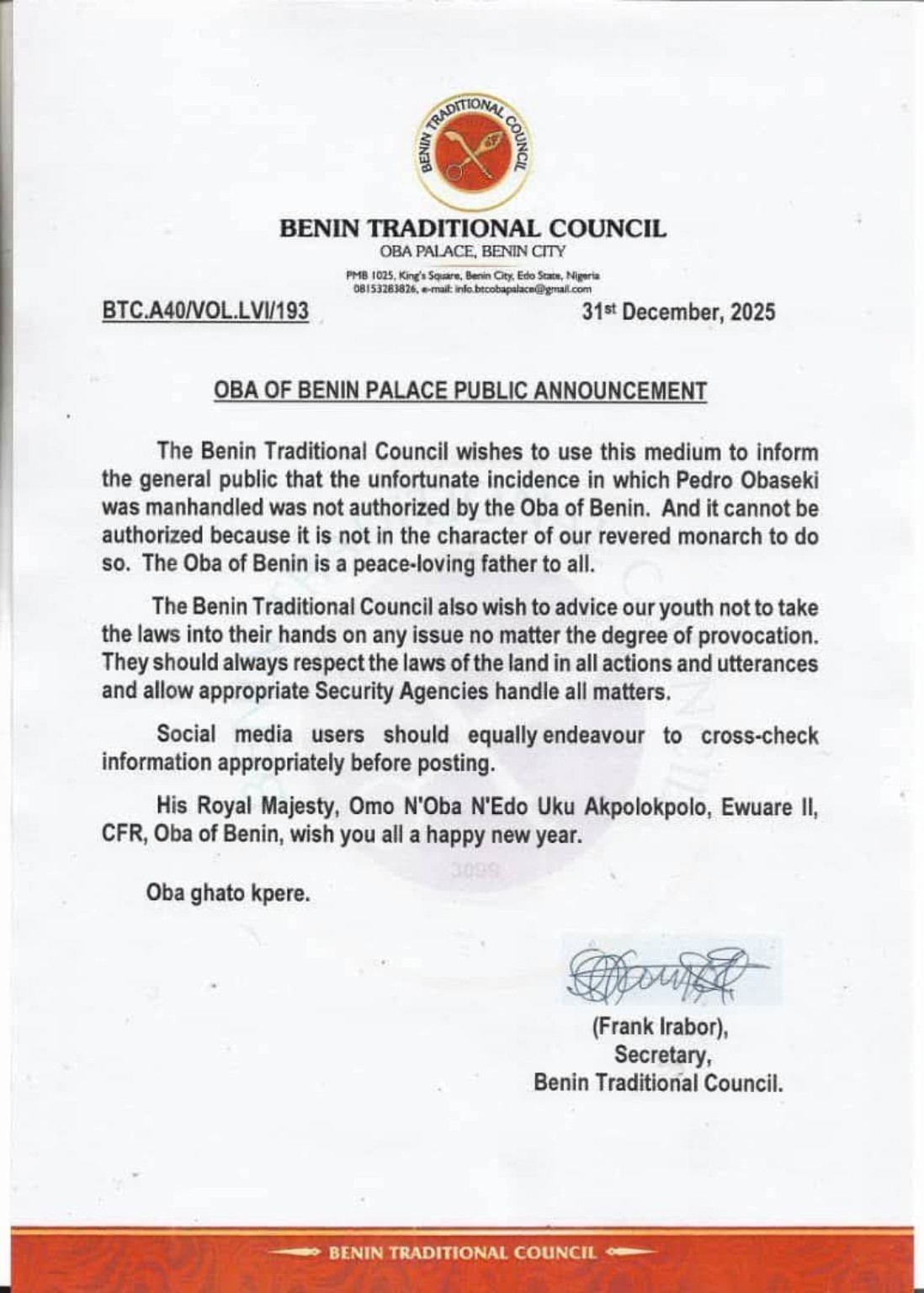
This public announcement by the Benin Traditional Council (BTC), dated 31 December 2025, is not merely disappointing; it is a direct affront to public reason and to the dignity of Dr. Pedro Obaseki. It fails the basic test of honesty, responsibility, and moral leadership expected from an institution that claims authority over a people. When read against the weight of Benin’s own historical record—from pre-colonial times to the present—the statement does not exonerate the throne; it indicts it.
The Insult of Euphemism: “Manhandled” as a Cover for Brutality
The Council’s choice of the word “manhandled” is a deliberate distortion of reality. On 28 December 2025, Dr. Pedro Obaseki was abducted by armed men at a primary school, stripped naked in public, beaten, and marched for over five kilometers through Benin City.
This was not disorderly conduct. It was kidnapping, assault, and public degradation. To soften these acts with polite language is to trivialize violence and to lower the seriousness of crimes that offend both law and conscience. This is not poor wording; it is calculated minimisation—an old tactic with deep roots.
Historically, the language of power in Benin has often reduced extreme violence to ritual or discipline. Pre-colonial records and oral histories show captives seized, dragged before authority, and subjected to punishment or sacrifice under euphemisms of “justice” and “custom.” The present wording follows that same pattern: reduce the act, protect the institution.
All Roads Led to the Palace: History Repeats Itself
The claim that the Oba did not “authorize” the incident collapses under the weight of both facts and precedent.
The attackers did not take their victim to a police station. They did not hand him over to lawful authorities. They dragged him directly to the Oba’s Palace.
This is not accidental. In Benin’s historical practice, the palace has long been the terminal point for extrajudicial seizures. From pre-colonial times, individuals accused of offending the crown or powerful chiefs were forcibly brought before the palace or its representatives. War captives in the nineteenth century were marched into Benin City and processed through palace authority; some were executed, others enslaved, others “cleared” through ritual decisions. Colonial records from 1897 describe captives taken by force and held under royal authority, with the Oba either presiding over or benefiting from these acts.
The pattern is clear:
abduction → palace → judgment or release.
That same pattern appeared in 2019, when a royal family member publicly alleged he was forcibly taken to the palace and compelled to undergo a coercive oath ritual involving forced drinking of a concoction. The symbolism was unmistakable: water given at the palace was not mercy; it was submission.
Dr. Obaseki’s ordeal follows this same historical script.
This raises unavoidable questions:
- Why did these men believe the Palace was their proper destination?
- Why were Palace guards not alarmed by a naked, battered man brought to the gates?
- Why did the victim reportedly require “clearance” before his release?
These are not the actions of random criminals. They mirror a long-standing institutional culture in which forceful seizure is validated when it ends at the palace.
“Character” Is Not a Defense—History Rejects It
The Council hides behind claims about the Oba’s peaceful nature. This argument is hollow.
Historically, Benin monarchs were often described as benevolent fathers while simultaneously presiding over severe punishments. Pre-colonial authority relied on absolute power tempered by discretion, not restraint. Mercy existed—but only after capture, humiliation, and total submission. That tradition does not vanish because modern language is softer.
Personal reputation does not erase institutional responsibility. Violence does not disappear because authority insists it is benevolent. If the Oba is truly a father to all, then the failure to prevent, stop, or immediately punish this act is not a minor lapse—it is a continuation of an old system where harm is tolerated until public pressure intervenes.
Peace is not declared. It is enforced through restraint. Authority that cannot restrain those acting in its name has forfeited its moral claim.
Gaslighting the Public Instead of Confronting Crime
Rather than naming perpetrators or announcing sanctions, the Council turns its attention to warning social media users.
This, too, has precedent. Historically, dissent in Benin—whether in speech, rumor, or public criticism—was treated as a threat to authority rather than as a call for accountability. The modern warning about “misinformation” follows that same instinct: control the narrative, not the violence.
The facts remain:
- No names of attackers are provided.
- No internal inquiry is announced.
- No apology is offered to the victim.
Instead, citizens are cautioned to be careful. This is not guidance; it is intimidation by implication. It shifts scrutiny away from Palace-linked violence and redirects it toward witnesses, journalists, and the public.
Institutions that fear exposure more than injustice betray their purpose.
Accountability or Complicity: History Leaves No Middle Ground
This announcement is not a defense; it is an admission of institutional failure.
Across Benin’s history—pre-colonial, colonial, and post-colonial—abductions that ended at the palace were never random acts. They were acts carried out with the expectation of approval, protection, or retroactive validation. That expectation did not arise overnight. It was built over centuries.
Men identified by name in Dr. Obaseki’s petition allegedly carried out this act while invoking Palace authority. Until those men are surrendered to law enforcement, and until Palace functionaries who enabled this abuse are questioned, the Palace remains implicated.
The public is asked to believe that armed men independently abducted a prominent citizen, paraded him naked, and delivered him to the Palace gate for no reason. History rejects this claim. Logic rejects it. Experience rejects it.
Respect for tradition is earned through justice, not demanded through silence.
Conclusion: Silence Is Not Peace—It Is Continuity
This statement does not distance the Oba from the incident; it tightens the link. It reflects an institution more invested in preserving inherited power than in correcting inherited abuses.
Responsibility does not dissolve because a press release says so. Until there is:
- Clear condemnation of the act
- Visible consequences for those involved
- Public respect shown to the victim
the Palace cannot be separated from this wrongdoing.
Tradition does not stand above accountability. Authority without restraint becomes abuse. Silence, in moments like this, is not wisdom—it is continuity.
The Nigeria Police Force must now act without fear or favor. The named assailants must be arrested, and Palace personnel who allowed this act to reach Palace grounds must be investigated. The 1999 Constitution applies to all, without exception.
Justice must not only be done; it must be seen to be done, or Edo State risks sliding into sanctioned mob rule—this time not by ancient custom, but by modern failure to confront it.

You must be logged in to post a comment.