
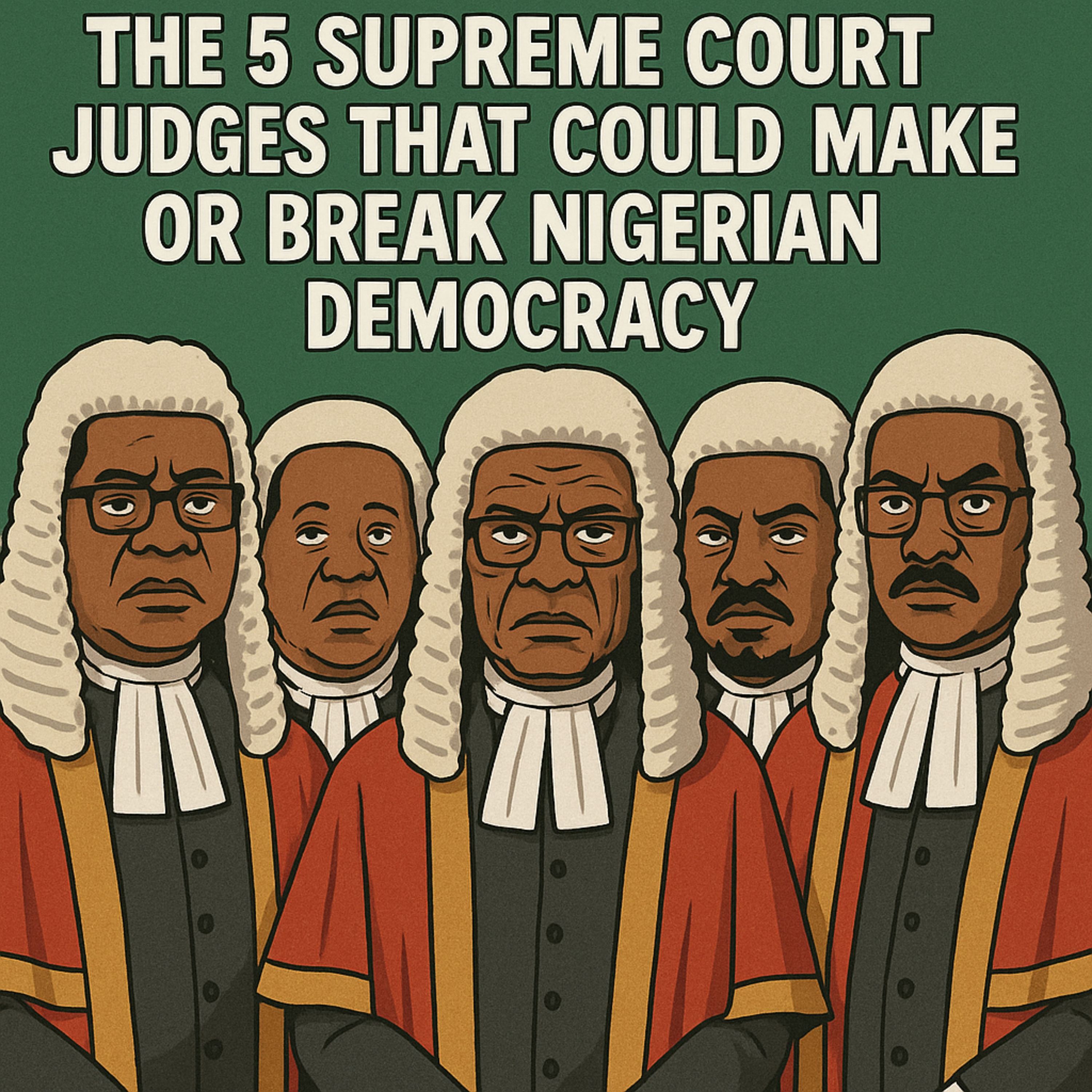
The five justices tasked with deciding the Edo State 2024 governorship election case at Nigeria's Supreme Court carry immense responsibility for the country's democratic trajectory. Their decision will either strengthen public confidence in electoral justice or potentially deepen concerns about judicial independence. This comprehensive analysis examines each justice's background, track record, and likelihood of delivering a judgment that upholds democratic principles.
The stakes for Nigerian democracy
The Edo 2024 governorship election petition represents more than a local political dispute. The case tests whether Nigeria's highest court can maintain judicial independence in politically charged electoral matters. The People's Democratic Party (PDP) and its candidate Asue Ighodalo are challenging the victory of All Progressives Congress (APC) candidate Senator Monday Okpebholo, who won with 291,667 votes against Ighodalo's 247,274 votes.
The petition alleges widespread irregularities, over-voting in 765 polling units, and violations of the Electoral Act 2022. Both the Election Petition Tribunal and Court of Appeal have already dismissed the PDP's challenge, citing insufficient evidence and failure to call crucial witnesses. The Supreme Court heard arguments in July 2025 and reserved judgment indefinitely, creating uncertainty that affects governance in Edo State and sets precedents for future electoral disputes.
This case occurs against a backdrop of declining public confidence in Nigeria's electoral system. The outcome will influence the conduct of the 2027 general elections and either strengthen or undermine faith in democratic institutions. The judgment will also establish critical precedents for interpreting the Electoral Act 2022 and standards of evidence required in election petitions.
Justice Mohammed Garba Lawal: The presiding justice with a controversial pattern
As the presiding justice, Justice Mohammed Lawal Garba's role carries particular weight in shaping the panel's deliberations. Born in 1958 in Zamfara State, Justice Garba brings over 40 years of legal experience, having served as Chief Judge of Zamfara State and in various Court of Appeal divisions before his Supreme Court appointment in November 2020.
His election petition track record reveals a troubling consistency. As chairman of the 2019 Presidential Election Petition Tribunal, he dismissed challenges to President Buhari's victory. In the 2023 Lagos State governorship case, he upheld Governor Sanwo-Olu's election while dismissing both Labour Party and PDP appeals. No documented case exists where Justice Garba has overturned an election result in favor of an opposition party.
While no direct corruption allegations have been made against him, his pattern of consistently upholding incumbent victories raises questions about institutional bias. His approach emphasizes strict procedural adherence and deference to electoral bodies unless clear legal violations are proven. This conservative, technically-focused methodology suggests he will likely maintain consistency with his previous judgments, potentially disadvantaging the PDP's challenge regardless of substantive merit.
Justice Habeeb Adewale Abiru: A beacon of substantive justice
Justice Abiru represents the panel's strongest advocate for substantive justice over technical proceduralism. Appointed to the Supreme Court in February 2024, he brings specialized expertise in conflict of laws and a documented commitment to looking beyond technicalities.
His integrity credentials are impeccable - no allegations of corruption or misconduct have emerged throughout his career progression from Lagos State High Court (2001) through the Court of Appeal (2012) to the Supreme Court. Legal practitioners describe him as a "worthy addition" known for thorough preparation and intolerance of unpreparedness in lawyers.
Most significantly, Justice Abiru has explicitly advocated that judges should "look beyond technicalities and go for substantive justice." His dissenting opinion in Niger Aluminium Manufacturing Co. Ltd v Union Bank demonstrated willingness to challenge majority views when proper legal principles are at stake. His election tribunal experience and academic writings on judicial reform suggest he will bring rigorous analysis to the Edo case, potentially serving as a counterweight to more technically-focused colleagues.
Justice Jummai Hannatu Sankey: Technical expertise shadowed by past allegations
As one of the few female Supreme Court justices, Justice Sankey brings both distinction and controversy to the panel. Her career includes significant anti-corruption victories, such as voiding improper state pardons in a N15 billion fraud case. She currently serves as President of the National Association of Women Judges.
However, her election petition record raises concerns. In the 2019 Osun State governorship case, she led the Court of Appeal panel that set aside a tribunal judgment on grounds of "faulty composition" rather than addressing substantive issues. Her approach in the 2023 Ebonyi State case similarly focused on jurisdictional and standing issues rather than electoral merit.
Most troubling are the 2016 allegations that she received a N350 million bribe from Governor Olusegun Mimiko to influence election decisions. While she properly recused herself and no formal charges resulted, the allegations cast a shadow. Her pattern of dismissing election petitions on technical grounds suggests she may prioritize procedural compliance over substantive electoral justice - potentially problematic for a case requiring careful weighing of alleged irregularities.
Justice Tijjani Abubakar: Clean reputation but concerning unanimity
Justice Abubakar presents a paradox - unimpeachable personal integrity coupled with a perfect record of dismissing opposition election challenges. The Yobe State native, appointed to the Supreme Court in November 2020, has no corruption allegations and consistently emphasizes anti-corruption principles in his judgments.
His judicial philosophy actually favors substantial justice, having ruled that dismissing cases on technical grounds like expired legal practitioner stamps "would amount to enthroning technicalities over substantial justice." Yet his election petition decisions tell a different story. He served on the 2023 Presidential Election panel that upheld Tinubu's victory and has consistently affirmed APC victories in Kano, Ebonyi, and Ogun states.
This pattern suggests either rigorous evidence standards or potential institutional bias toward the ruling party. While his integrity remains intact, his electoral jurisprudence shows unwavering support for declared results, raising questions about whether he can objectively assess opposition challenges. His likely approach will involve strict evidence requirements that could disadvantage the PDP's claims regardless of their substantive merit.
Justice Obande Festus Ogbuinya: Philosophical commitment meets practical concerns
The newest member of the panel, Justice Ogbuinya was appointed to the Supreme Court in February 2024 after distinguished service in Ebonyi State High Court and the Court of Appeal. His judicial philosophy strongly favors substantive justice, colorfully stating that case law has "slaughtered technicality and buried its carcass deeply under the temple of substantial justice."
His election petition experience includes the landmark Agbaje vs. Ambode case (2015), where he ruled that card readers cannot determine election results since they lack statutory backing. While legally sound, this decision has been criticized for potentially limiting electoral transparency measures. His international recognition includes appointment to hear President Jammeh's petition in Gambia, demonstrating expertise in high-stakes electoral disputes.
With no corruption allegations and explicit commitment to substantive justice, Justice Ogbuinya appears likely to engage seriously with the merits of the Edo petition. However, his relatively recent Supreme Court appointment and the precedent-setting nature of his card reader ruling suggest a cautious approach that may still favor electoral finality over disruption.
Assessing the panel's likely approach to democratic principles
The composition of this five-justice panel presents a complex picture for Nigerian democracy. Two justices (Abiru and Ogbuinya) demonstrate strong commitment to substantive justice, while three (Garba, Sankey, and Abubakar) show patterns favoring technical dismissal of election challenges.
The presiding justice's consistent record of upholding declared results, combined with Justice Sankey's technicality-focused approach and Justice Abubakar's perfect record against opposition parties, suggests the panel may lean toward dismissing the PDP's petition. The newer justices, while philosophically committed to substantive justice, may defer to their senior colleagues' approach.
Critical factors that could influence the outcome include the quality of evidence presented regarding the alleged 765 polling units with irregularities, the panel's interpretation of the Electoral Act 2022's provisions, and whether the justices prioritize electoral finality or substantive investigation of alleged violations.
Implications for Nigeria's democratic future
The Edo 2024 case represents a watershed moment for judicial credibility in Nigeria's electoral system. A decision that transparently engages with substantive allegations rather than dismissing on technicalities would strengthen democratic institutions. Conversely, another technical dismissal following established patterns would deepen concerns about judicial independence.
The panel's integrity profiles suggest minimal risk of outright corruption influencing the decision. However, institutional biases favoring electoral stability over substantive justice pose a subtler threat to democratic principles. The presence of justices like Abiru and Ogbuinya offers hope for rigorous legal analysis, but their influence may be limited by seniority dynamics and precedential constraints.
For Nigerian democracy to thrive, the Supreme Court must demonstrate that electoral disputes receive fair, substantive consideration regardless of which party benefits. The Edo case provides an opportunity to either reinforce public faith in judicial independence or further erode confidence in democratic institutions. The indefinite reservation of judgment only heightens these stakes, as prolonged uncertainty affects both governance in Edo State and national perceptions of electoral justice.
The ultimate test will be whether these five justices can transcend individual patterns and institutional pressures to deliver a judgment that genuinely upholds the principles of electoral integrity and democratic governance that Nigeria's constitution demands.

You must be logged in to post a comment.