
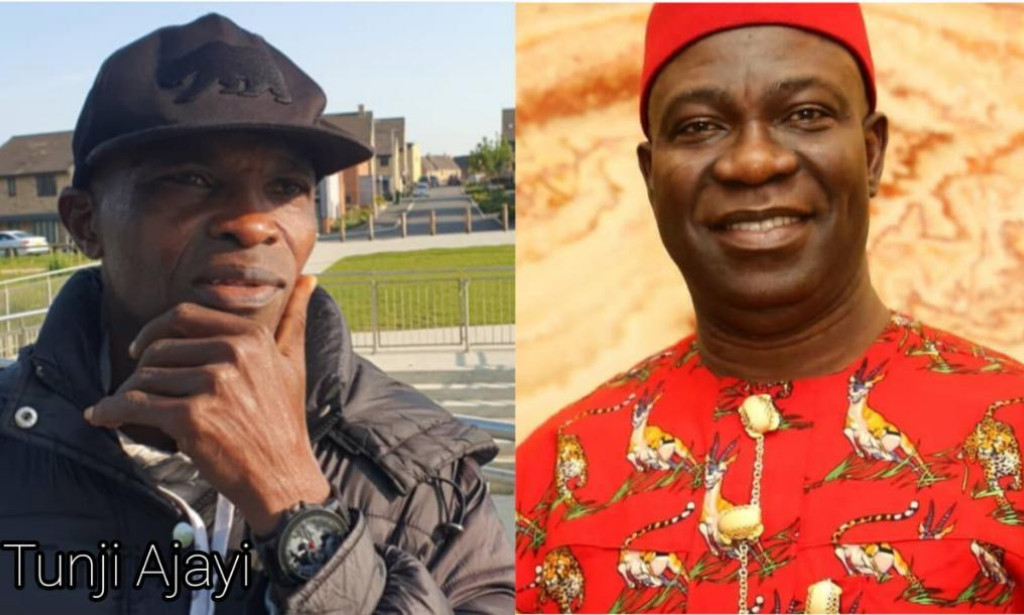
EKWEREMADU’S TRAVAILS & THE REST OF US ( Part 2): The Legal Conundrums
- By ‘Tunji Ajayi
(A Voice from the Garden of England)
I wrote about the delicate issue of loyalty test earlier in “Ekweremadu’s Travails & The Rest of Us – Casting the First Stone (Part 1)" (See Ohio Wesleyan University Press, May 13, 2023) I am now inclined to present the Part 2 with the subtitle: "The Legal Conundrums". My position on this subject should not be mistaken as tacit support for an ignoble action as horrendous as organ trafficking. I am an unrepentant advocate on preservation of human dignity. Both the poor man and the affluent are delicate creations of God in His image. That alone is a reason to respect human body members. Consequently, any attempt to diminish humankind, extort other persons, trade or tamper with human parts is opprobrious and condemnable. However, having heard the judgment of the London Old Bailey’s Court, and against the backdrop of the fact that only God can claim infallibility, I am inclined to X-ray some of the key ingredients which form the fulcrums of the court decision. After all, justice connotes the application of inviolable truth and unassailable facts. First, it is certain that if the act had occurred in Nigeria, Ekweremadu would probably not have been a victim of such stringent law that bounds him.
Perhaps what Oliver Goldsmith, the Irish born English writer said in his 16th century book “The Traveller” is truer of Nigerian situation than elsewhere. Hear him: “Law grinds the poor, and the rich man rules the law”. On the other hand, the words of an English philosopher Francis Bacon that some “laws were like cobwebs where the small flies were caught, and the big ones break through" seems apropos to Nigerian situations. One of the key ingredients of the rule of law is equality before the law; but which is yet to thrive in Nigeria where the rich man rules the law.
But one man’s meat is another man’s poison. United Kingdom laws and legal system neither believe in what the maverick musician Fela Anikulapo-Kuti calls “Power Show” nor preferential treatment to “Very Important Personality” – the VIP syndrome. Even then, the law that was flouted and which sent Senator Ike Ekweremadu to jail was novel in the history of United Kingdom. According to Lynette Woodrow, Deputy Chief Prosecutor of the Crown Prosecution Service (CPS): ". . . this is our first conviction for trafficking for the purposes of organ removal in England and Wales”. The rule of law enshrined in the legal maxim: “Nullum crimen, nula poena sine lege” emphasizes that an accused person cannot be made to suffer punishment for an offense for which there is no law in existence forbidding the act. The only exception in Nigeria was the Buhari-Idiagbon regime of 1983 that made a law banning drug dealings, and instantaneously having retroactive effect, by which some Nigerians were summarily executed for the breach of non-existing decree. Unfortunately, Ekweremadu sinned against UK law and not Nigerian law where he would have been set free.
However, many became apathetic to his situation arguing that Nigerian hospitals are in decrepit state till today even after Ekweremadu had served the nation at a very vantage and influential status for almost 20 years enough to have made impact and remedy the situations. Not much happened to the state of our hospitals. In fact the situation got worse that our doctors and nurses emigrated in droves in search of Golden Fleece in the same United Kingdom and other overseas countries. Perhaps if Ekweremadu as the deputy senate president had influenced the legislature to pass relevant bills to improve our hospitals, he would not have had to seek remedy for his ailing daughter in a foreign land. And perhaps he would not have suffered this fatal fate. "Èèpà n pa’ra è, ó ní ò n pa’já.” - The ravenous worms live inside the Dog but relish feeding fat on her intestine. Unknown to the indiscreet greedy Worms the day the Dog dies is the day the worms will also die. Nigerian leaders rather than improve the country’s infrastructure revel in feeding fat on Nigerian resources and bleeding it to untimely death.
Though, on moral ground, the manner of attempting to solve Sonia’s kidney problem had been roundly condemned. But the truth is that kidney transplant had been a known medical solution ever since; provided there was “consensus ad idem” in legal parlance, viz; the agreement of two minds, i.e. the mutual consent between the donor or his/her agent and the beneficiary. But my worry is this. Couldn’t have been mutual consent between Ekweremadu’s lawyer Dr. Obinna Obeta and David Nwamini who was first presented as a 21-year old man, and suddenly he became a 15-year old boy? Could he have been tutored surreptitiously on age implication at the hearing stage prior the hitherto unknown court position and the “ratio decidendi” viz the fulcrum on which court decision is/or will rest? Legal age in UK is 18 years. The lower David Nwamini’s age, the worse Ekeremadu’s case. Our court of law is the last hope of common man. Okay. But permit me to quote a respected learned jurist’s popular aphorism here. While talking about the power of the court, the late Justice Chukwudifu Oputa of the Supreme Court said: “We are final not because we are infallible; rather we are infallible because we are final”. This, after all shows that in spite of the court being a final arbiter in both civil and criminal cases, they are not infallible!
Thus, In “Another Look at Those Draconian Decrees” (Daily Sketch, November 29, 1985) I averred: “Our court of law, as we are made to believe, stands for justice. Justice connotes the quality of being right and fair. Therefore, when a matter becomes a subject of litigation, we expect nothing other than justice, because the court, we are told, stands for fairness, equity and justice. However, for quite a very long time now, I have been greatly puzzled and extremely in doubt of the veracity of the claim . . .” Thus, to what extent can we get justice from our court of law - the final arbiter, if they are not infallible as Justice Oputa admitted? In Ekweremadu’s case, it is pertinent to revisit and ask these questions: Didn’t the complainant consent to donating his kidney for transplant into Sonia the sick, before being taken to London? Dr. Obinna Obeta, the “middleman”, we are told is a London-based medical officer. He couldn’t have been easily reachable by virtue of his status and location. The 21-year old (later 15 year old) David whose kidney was to be harvested was “a poor street trader in Lagos”. According to him, he was offered a sum of “£7,000; and promised job opportunities in UK” and then flown to London, only to discover the deal “was for a different purpose” i.e., kidney removal and transplant into another person, viz Ekweremadu’s ailing daughter Sonia. The following premise(s) can be drawn before logical deductions:
<>If by legal definition, a fiduciary relationship is one that a party is placed in a position of trust and confidence, to act on the person’s behalf, or in his interest; couldn’t there have existed such fiduciary relationship and long discussion/agreement between Dr. Obinna the middleman and David before being flown to UK? <>How could David Nwamini, a street hawker have had direct access at all to a well educated Dr. Obinna without an understanding and a deal? <>For what was the sum of £7,000 offered David Nwamini and where, and/or by what means did the deal take place? <>David Obinna could be a poor street hawker, but where were his parents or close relations especially shortly before and immediately after he was flown abroad; and before David’s allegation of “poor treatment” which later became “my body part is not for sale”? <>At what stage did the parents react to his being flown abroad? Was it before he was flown abroad at all, or after he got to UK - his long-sought ambition? - According to David Nwamini the poor street hawker, “I had been praying since many years to have opportunity of travelling abroad” <>Expectedly, David Nwamini after the judgment was then praying to UK not to send him back to Nigeria. Good. If those premises were established, won’t the following be plausible deductions? Though the Crown rebuffed legal age as being inconsequential in any case of trans-border trafficking and that “consensus ad idem” notwithstanding, why was there any reduction from his real age – 21 years to 15 at all before David owned up to his “real” age in court? Was there any hibernation for the law, mainly for the prosecution to twist fact for whatever reasons? In other words, wasn’t their “mens rea”: viz: premeditated intention to hibernate the court and twist fact with a view to implicating Ekweremadu by all means? Wouldn’t “actual commission” viz: to implicate a respondent “actus reus” in this case a wrongful act? From the above, may I therefore suspect:
>That David and Dr. Obinna may have had agreement on a kidney transplant. Though, most kind people often donate organ, but the propensity to donate for an agreed sum by a poor, “fed-up” hawker and struggling man on Nigerian street is higher than by an averagely rich and comfortable person. >For economic reason in a depressed and clueless society of Nigeria status, evidences abound that most parents have done bizarre and illegitimate acts like child trafficking, forming Yahoo Boys Parents Association etc., to survive. Many are unprintable and are a result of systemic failure. Ordinarily, Nigerians are most resourceful and hardworking people in the world. >David Nwamini loves UK long before this issue, apparently having been disenchanted with Nigerian dismal situations. Thus, expectedly, he is now pleading not to be sent back home having achieved his long-sought aim.
While one may agree with what appears like the “ratio decidendi” of Old Bailey’s Court decision that “any consent or agreement to be extorted, or trade in body organ is illegal regardless of consent”, The UK Court held that a man cannot consent to be extorted. Good. We pray that Nigerian body of laws be elevated to that level. Extortions on daily basis permeate our social and working relationship with employers. Casual workers are extorted on daily basis with or without their consent as they are forced to work without holidays or rest with stipends and peanuts erroneously called monthly salaries. Nigerians pay for electricity that is neither available nor consumed. Automobile vehicle users pay for “Certificate of Road Worthiness” and “Vehicle License” for plying crater-ridden unworthy roads making their vehicles tattered. Banks don’t pay interest on customers’ savings but extort them through ridiculous and multiple bank charges. Police threaten road users and create fears to extort on the roads. Private schools extort the innocent parents who pay heavily for their children school fees, since the public schools are moribund and in dilapidated state. Government engages in institutional extortions and state governments have even been accused of illegally spending poor civil servants’ cooperative funds, etc.
We live in a society where “a beggar has no choice” as the cliché goes. Thus, a jobless man will literally jump at any extortionate contract of employment. The Yoruba adage says: “Wípé Ìresì n pà’kúta, enu oní báárà kó laó ti gbó” - That a gifted meal of rice has pebbles should not be heard from a beggar. The great lesson is that while Nigerian law seems permissive in pampering “big men” and “Very Important Personality” – VIP, the UK and other nations have put law and order in place for everybody to respect regardless of status. Nigeria “cobweb” law allows big flies, (the VIP) to enter and go out free, while small flies, (the common man) enter the cob web and get caught.
Many Nigerians pleaded on behalf of the Ekweremadus. It is natural that people express sympathy for others. But as being argued, could Chief Olusegun Obasanjo’s plea to the Crown have come much earlier? The court recognizes the position of “amicus curiae” i.e. friend of the court who often are not party to disputes, but more often to help the court by shedding light on grey issues. Obasanjo’s letter and the interventions by Ekweremadu’s influential friends could not have come much earlier than they did; otherwise it would amount to interference with the course of justice. Moreover, such pleas at the appropriate time, in law are typical of “alocutus” which are often for clemency to reduce the severity of court punishment for an accused person who, by “audi alteram partem” doctrine is presumed innocent until duly tried and pronounced guilt by the approved court of law. Alocutus may only come after all evidences have been taken and the accused found guilty before verdict is pronounced.
As regards allowing David Nwamini to stay in UK in response to his plea, my personal opinion rests in the legal maxims viz: "Nudum Pactum Non Oritur Actio" suggesting that no action can arise from a contract for which no “consideration” was given. In other words the value of equal proportion must be given for a promise made to validate a contractual agreement. Thus, Curie v Misa (1875) defines “Consideration” in legal parlance as some rights, interest, profits, benefits etc accruing to one party, and some detriments, forbearance, loss given, suffered or undertaken in respect of a contractual agreement by the other party. Except for Old Bailey’s “ratio decidendi” that “no man can consent to be extorted” and that “consent is immaterial in a case of organ trafficking”, for me it seems David Nwamini truly entered an agreement for which a “consideration” had passed by virtue of his consent to take £7,000 in return for a “job opportunities in UK .”
Again, supposing two thieves are fighting on a sharing formula for a stolen property; and one of the aggrieved parties had the audacity to go to court to seek redress, who will the court give relief? Of course, none? Hence the maxim “In pari delecto, potio ex conditio defendentis” which seems to suggest that where two wrongs are equal to blame, the position of the defendant remains stronger. Why? Because the plaintiff, (e.g. fellow thief complaining) will not be helped. Thus, the “status quo ante” of the defendant remains. If by Old Bailey Court’s decision is that “no one can consent to be extorted” and that any trans-boarder agreement to trade on human parts is illegal, then to me all the parties to such an agreement should be deemed to have erred in law. Thus, both David and Ekweremadu are “equal to blame”. Consequently, since the Ekweremadus and his middleman were pronounced guilty, the victim David Nwamini should also not be helped to stay back in UK; lest he benefits from an illegal transaction. Without attempting to be obtrusive, I apologize to my learned friend for discussing a delicate issue in their domain.
The truth is that I am not learned, needless being a lawyer. I am just a writer and ex-journalist trained to “know something about everything; and everything about something” But my consolation lies in Miguel de-Unamuno’s averment. Hear the Spanish philosopher: “Every peasant has a lawyer inside of him, just as every lawyer, no matter how urbane he may be carries a peasant within him.” I tender my apology for attempting “to make use the lawyer in me.” May UK government grant support to Sonia to overcome her health challenges. May God send divine help to the girl and give her needed strength to bear these multiple travails. Verbum Satis Sapienti.
-----------------------------------------
*Tunji Ajayi, a creative writer, author and documentary producer on holiday presently writes from England. Kindly read and share Part 1 - Casting The First Stone
1Please like, comment, share, and subscribe to Henrisol Entertainments Ltd. Youtube Channel https://youtu.be/-XaKx3HyBb0
2Buy via Amazon: https://www.amazon.com/KING-SUNNY-ADE.../dp/B09FSCJX78
3Please watch out for the book: “MACABRE DANCE ON PERAMBULATOR: Essays on Nigerian Contemporary Issues” by Tunji Ajayi

You must be logged in to post a comment.