
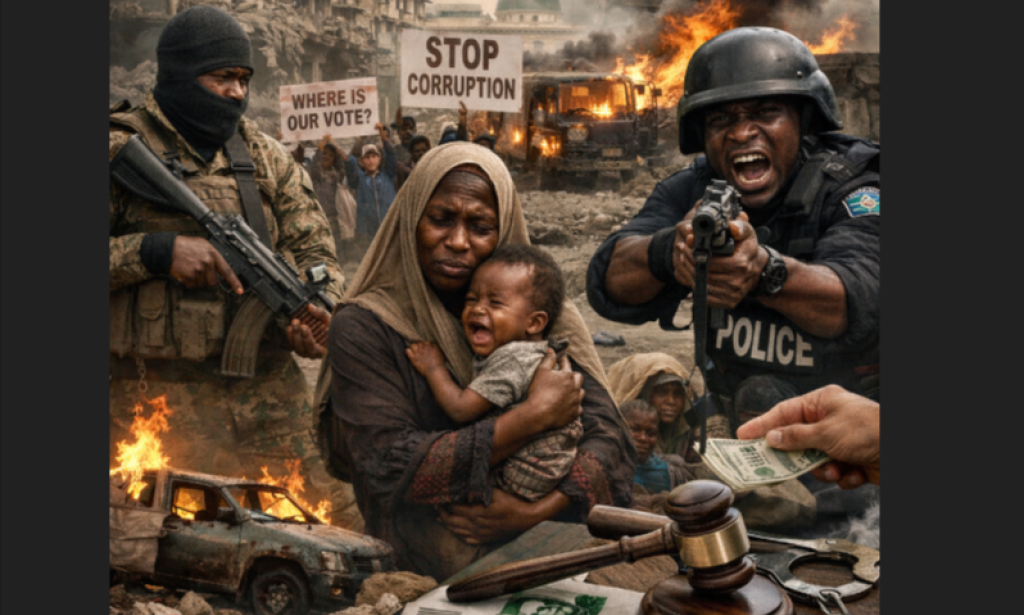
“Failed state” is a heavy label. It should not be used as an insult, but as a test of performance. A state is expected to do certain basic things: protect lives, apply law fairly, run credible elections, and provide public services that people can trust. When those functions collapse across wide parts of the country—year after year—the argument that the state is failing becomes difficult to dismiss.
Nigeria now fits many of the core signs used by global fragility and governance trackers. The Fragile States Index places Nigeria among the world’s most fragile countries, with a 2024 score of 96.6 (higher scores reflect greater fragility) (Fund for Peace, 2024; TheGlobalEconomy.com, 2024). On corruption and rule-of-law measures, Nigeria also ranks poorly: Nigeria scored 26/100 on the Corruption Perceptions Index (CPI) 2024, ranking 140 of 180 (Transparency International, 2024a, 2024b), and it ranked 120 of 142 in the World Justice Project Rule of Law Index 2024 (World Justice Project, 2024).
This article argues that Nigeria is now, in practical terms, a failed state—not because the flag has disappeared, but because the lived reality for millions shows a state that cannot reliably perform its basic duties.
What “failed state” means in real life
A failed state is not only one that breaks into pieces. It is one where:
-
Security is weak and citizens are routinely exposed to violence.
-
Institutions (courts, police, electoral bodies) lose credibility and become tools for private gain.
-
Public trust collapses because the rules do not apply equally.
-
Order is replaced by informal power: ransom networks, gang control, political thugs, and vigilante enforcement.
That is the direction Nigeria has been moving for years, and recent evidence suggests the decline is continuing (Fund for Peace, 2024; World Justice Project, 2024).
Insecurity: when the state cannot protect life
The first duty of a state is simple: protect lives and property. Nigeria is failing this duty on a frightening scale.
Kidnapping has become a parallel industry. SBM Intelligence reported that 4,722 people were kidnapped between July 2024 and June 2025, and widely cited reporting describes ransom payments in the billions of naira during that period (SBM Intelligence, 2024; Vanguard, 2025). The National Human Rights Commission’s public dashboard summaries have also documented grim monthly figures—for example, 570 killings and 278 kidnappings recorded for April 2025 (National Human Rights Commission, 2025a, 2025b).
When the formal system cannot secure communities, people turn to informal protection. That can mean vigilante groups, ethnic militias, or mob justice. Such trends are widely recognized signs of institutional breakdown because they show citizens no longer believe the state can enforce safety and law (Associated Press, 2025).
A state that cannot consistently stop kidnapping, mass violence, and retaliatory killings—while citizens adopt self-help security—has already lost one of the most important features of statehood: monopoly of legitimate force.
The police: feared, distrusted, and often ineffective
A functioning police force is one of the clearest markers of a functioning state. Nigeria’s policing crisis is not just about low capacity; it is also about public distrust, driven by repeated accusations of abuse, extortion, and excessive force.
Amnesty International has continued to report allegations of serious police abuses, including violent repression of protests and ongoing brutality years after the #EndSARS movement (Amnesty International, 2024a, 2024b). When citizens fear the police, they avoid reporting crimes, avoid cooperating, and avoid seeking justice. That destroys intelligence gathering, weakens investigations, and creates space for criminal networks to grow.
Corruption data also matters here. The UNODC/NBS corruption survey work on Nigeria has documented persistent bribery in interactions with public officials and patterns that damage trust in enforcement institutions (United Nations Office on Drugs and Crime [UNODC], 2019).
In practice, many Nigerians experience the police not as protection, but as a risk—a checkpoint where money must be paid, a station where cases stall unless “something is dropped,” or a force that arrives late, if at all (Amnesty International, 2024a; UNODC, 2019). A state cannot stand when its most visible frontline institution inspires fear more than confidence.
The judiciary: justice that too many people believe can be bought
A state becomes weak when citizens conclude that the courts are not a place to seek justice but a place to bargain.
The World Justice Project’s Rule of Law Index 2024 ranks Nigeria 120th out of 142, reflecting deep rule-of-law weaknesses (World Justice Project, 2024). Beyond rankings, detailed research has examined judicial bribery and the social expectations that normalize corrupt court outcomes, including how bribery and procurement fraud link to wider governance failure (Hoffmann, 2024).
This is not a minor problem. If courts are not trusted, then:
-
Election disputes become endless legitimacy battles.
-
Contract enforcement collapses and investment confidence falls.
-
Citizens shift to private settlement, intimidation, or violence.
When legal outcomes are widely believed to depend on connections and payments, the state loses its moral authority—and the law becomes another commodity.
Elections and INEC: legitimacy damaged by process failures and distrust
Nigeria’s democracy cannot survive on elections that large parts of the public view as manipulated. It is not enough to vote; people must believe their votes count and results are credible.
The EU Election Observation Mission report on Nigeria’s 2023 general elections documented significant operational and transparency problems and offered reforms aimed at restoring confidence (European Union Election Observation Mission, 2023). INEC itself published an official Report of the 2023 General Election, reflecting the commission’s own review of the process and challenges (Independent National Electoral Commission [INEC], 2024). INEC later produced a formal Review of the 2023 General Election, which points to continuing debates about rules, technology, and procedures (INEC, 2024/2025).
This matters because a state’s legitimacy rests on public consent. When elections are viewed as uncertain, contested, or opaque, the result is predictable:
-
Winners govern under suspicion.
-
Losers reject outcomes permanently.
-
Courts become overloaded with political cases.
-
Citizens disengage or radicalize.
A country can be rich in resources and still fail if its political authority is widely seen as unearned.
Corruption: when public office becomes private business
Nigeria’s corruption problem is not a secret; it is measurable.
Transparency International reports Nigeria’s CPI 2024 score as 26/100, ranking 140/180 (Transparency International, 2024b). This indicates persistent corruption risks in public life. International reporting has also highlighted major anti-corruption recoveries and convictions while noting that the broader corruption challenge remains entrenched (Reuters, 2025).
Corruption becomes a state-failure issue when it moves from being “bad behavior” to becoming the operating system. When budgets leak, contracts are inflated, jobs are sold, cases are settled, and elections are influenced, then:
-
Services fail because money does not reach projects.
-
Institutions weaken because leaders are chosen for loyalty, not competence.
-
Citizens stop trusting the state and start gaming it.
In that environment, politics becomes business, and public suffering becomes collateral damage.
The wider picture: Nigeria matches the profile of a failing state
None of these crises stands alone. They reinforce each other:
-
Insecurity grows → communities lose faith in police.
-
Police abuse and corruption grow → citizens stop cooperating.
-
Courts are distrusted → disputes become violent or political.
-
Elections lose credibility → governance lacks legitimacy.
-
Corruption drains resources → services collapse and anger rises.
This is why Nigeria ranks so poorly on major fragility and rule-of-law measures (Fund for Peace, 2024; World Justice Project, 2024). The pattern is not random. It is the pattern of a state that is failing in core functions.
Nigeria is therefore not merely “struggling.” In many parts of daily life, Nigeria operates like a failed state.
Conclusion: Nigeria is failing—and a nonviolent civic revolution is the way out
If Nigeria continues on its present track, the outcome will not be stability. It will be a deeper slide into criminal power, regional insecurity, and permanent public mistrust.
However, the answer is not chaos or bloodshed. The only sustainable “revolution” for Nigeria is a nonviolent civic revolution—a disciplined, constitutional, citizen-driven transformation that forces institutions to work.
That civic revolution should demand:
-
Security reform that prioritizes citizen protection, intelligence-led policing, and accountable operations (National Human Rights Commission, 2025a; Amnesty International, 2024a).
-
Police accountability with transparent discipline systems and real punishment for extortion and brutality (Amnesty International, 2024b).
-
Judicial integrity reform that confronts bribery networks and protects honest judges (Hoffmann, 2024; World Justice Project, 2024).
-
Electoral transparency reform—results management, open auditing, and enforceable standards—so elections rebuild legitimacy (European Union Election Observation Mission, 2023; INEC, 2024).
-
Anti-corruption enforcement that targets high-level theft and closes procurement loopholes (Transparency International, 2024b; Reuters, 2025).
Nigeria is not short of talent or courage. It is short of institutions that people can trust. Until security, justice, elections, and accountability become reliable, Nigeria will continue to behave like a failed state—and citizens will continue to pay the price.
References (APA)
Amnesty International. (2024a, November 28). Nigeria: Police used excessive force to violently quash #Endbadgovernance protests. https://www.amnesty.org/en/latest/news/2024/11/nigeria-police-used-excessive-force-to-violently-quash-endbadgovernance-protests/
Amnesty International Nigeria. (2024b, October 20). Nigeria: Rampant police atrocities continue 4-years after #EndSARS protests. https://www.amnesty.org.ng/2024/10/20/nigeria-rampant-police-atrocities-continue-4-years-after-endsars-protests/
Associated Press. (2025, March 29). A mob in southern Nigeria kills 16 people they suspected of being kidnappers. https://apnews.com/article/764c183e27d5f2c46d51ba0d14f2c590
European Union Election Observation Mission. (2023). EU Election Observation Mission Nigeria 2023: Final report—General elections 25 February and 18 March 2023. European External Action Service. https://www.eeas.europa.eu/sites/default/files/documents/2023/EU%20EOM%20NGA%202023%20FR.pdf
Fund for Peace. (2024). Fragile States Index. https://fragilestatesindex.org/
Hoffmann, L. K. (2024). Tackling judicial bribery and procurement fraud in Nigeria. Chatham House. https://www.chathamhouse.org/sites/default/files/2024-10/2024-10-08-judicial-bribery-procurement-fraud-nigeria-hoffmann.pdf
Independent National Electoral Commission. (2024). Report of the 2023 general election. https://inecnigeria.org/wp-content/uploads/2024/02/2023-GENERAL-ELECTION-REPORT-1.pdf
Independent National Electoral Commission. (2024/2025). Review of the 2023 general election. https://inecnigeria.org/wp-content/uploads/2024/12/REVIEW-OF-THE-2023-GENERAL-ELECTION-1.pdf
National Human Rights Commission. (2025a, August 5). NHRC reports 570 killings and 278 kidnappings in April 2025. https://www.nigeriarights.gov.ng/nhrc-media/news-and-events/578-nhrc-reports-570-killings-and-278-kidnappings-in-april-2025.html
National Human Rights Commission. (2025b). Presentation of April 2025 dashboard (Final) [PDF]. https://www.nigeriarights.gov.ng/files/NHRC%20Dashboard/Presentation%20of%20April%202025%20Dashboard%20%28Final%29.pdf
Reuters. (2025, March 10). Nigeria's anti-graft agency recovers nearly $500 million in one year. https://www.reuters.com/world/africa/nigerias-anti-graft-agency-recovers-nearly-500-mln-one-year-2025-03-10/
SBM Intelligence. (2024). Economics of Nigeria’s kidnap industry: A 2024 update [PDF]. https://www.sbmintel.com/wp-content/uploads/2024/08/202408_Economics-of-Nigerias-kidnap-industry.pdf
TheGlobalEconomy.com. (2024). Nigeria: Fragile state index. https://www.theglobaleconomy.com/Nigeria/fragile_state_index/
Transparency International. (2024a). Corruption Perceptions Index 2024. https://www.transparency.org/en/cpi/2024
Transparency International. (2024b). Nigeria—Corruption Perceptions Index country page. https://www.transparency.org/en/countries/nigeria
United Nations Office on Drugs and Crime. (2019). Corruption in Nigeria: Patterns and trends (Executive summary) [Report]. https://www.unodc.org/documents/nigeria/Corruption_Survey_2019_Exsum.pdf
Vanguard. (2025, August 27). Insecurity: 4722 abductions, N2.57bn ransom paid to kidnappers in one year—Report. https://www.vanguardngr.com/2025/08/insecurity-4722-abductions-n2-57bn-ransom-paid-to-kidnappers-in-one-year-report/
World Justice Project. (2024). Rule of Law Index 2024: Nigeria country profile [PDF]. https://worldjusticeproject.org/sites/default/files/documents/Nigeria_2.pdf

You must be logged in to post a comment.