
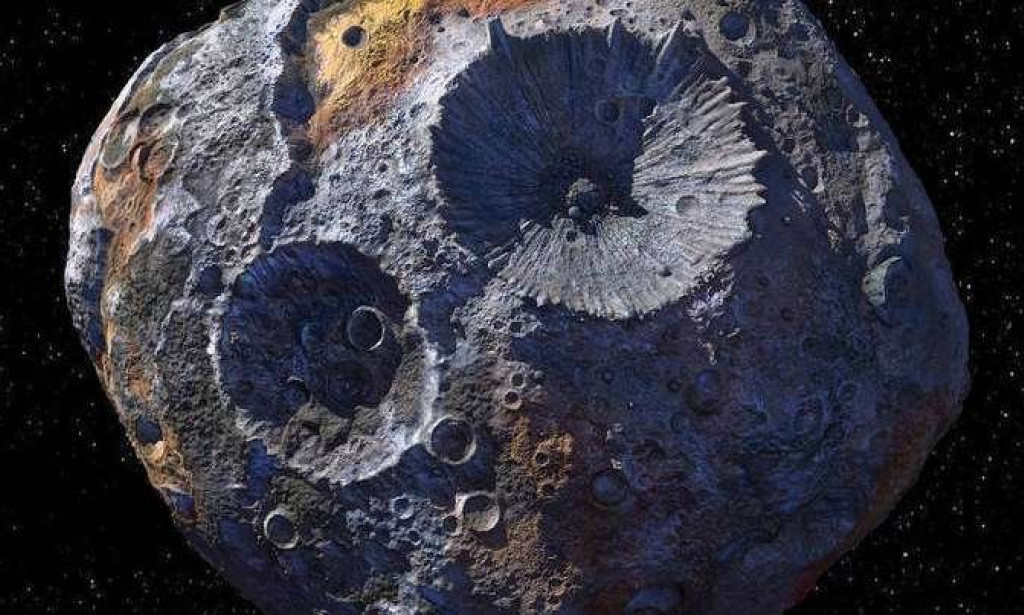
NASA, the American space agency, will launch a space mission in August this year with the goal of exploring a space rock that contains more metals than the whole global economy combined. Psyche 16 would be located in a region between the orbits of Mars and Jupiter, with an iron-just sum of $10 trillion.
The space office and Arizona State University will collaborate on the mission, which will be called (Psyche, in free interpretation) (ASU). The expectation is that the apparatus for investigating the surface of the space rock will arrive in 2026. The mission's space test will cover a massive distance of 2.4 billion kilometers over the course of four years. The device will use Mars' gravitational move to launch itself into the belt around which Psyche 16 revolves.
The test's cameras will turn on near the end of 2025, when it is preparing to deal with the space rock in its final form. According to NASA, this cycle is critical for mission security.
"The images will also help engineers organize themselves as they prepare to join the circle in January 2026. The underlying circle of the shuttle is supposed to be at a safe, high elevation, roughly 700 kilometers above the surface of the space rock "He clarifies his position. NASA, according to El Pas. Psyche 16 is also 200 kilometers across, according to the Spanish paper, and is thought to be the largest M-type space rock, rich in metals like nickel and iron. The metallic stone body is thought to be made up of fragments of what could be planet cores that were broken down during the formation of the Solar System.
Lindy Elkins-Tanton, ASU analyst and mission chief, clarifies, "Deeply, it would be the original of primitive centers in our planetary group."

You must be logged in to post a comment.