
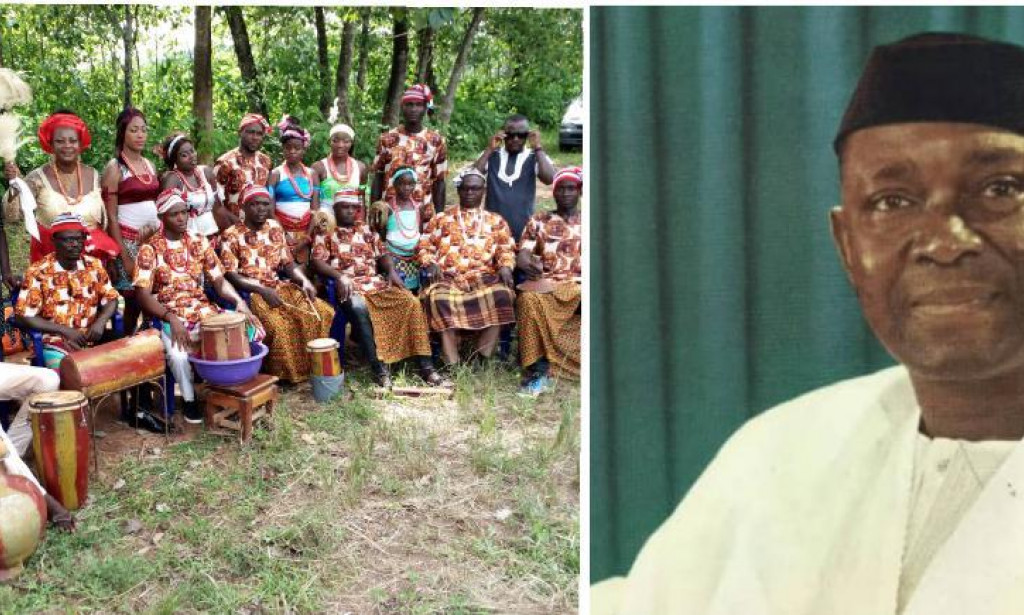
NKWUMAGBOGHO! PRISTINE BEAUTY OF A CULTURAL DANCE ART: How a Maiden Won the Heart of Great Zik of Africa -
By ‘Tunji Ajayi
I love Meki Nzewi’s apt definition of dance. The Professor of African Music said: “It is stylized and structured movement in time space. He went on. “In the context of Nigeria’s artistic conceptions, dance involves, or at the marginal, implies music.” His definition suggests that both dance and music are like Siamese twins, inexorably connected; and just like mistletoe often clings onto the nearby trees, music and dance perpetually tag along with each other. Thus, no music, no dance. On the other hand, Steven Mithen, in “The Origins of Music, Language, Mind and Body” defines music as a “cultural universal”. He meant “an element, pattern, trait, or institution that is common to all known human cultures worldwide.” His definition suggests that, just like dance, music is perhaps the most common traditional practice that cuts across almost all traditions and cultures the world over. Succinctly put, every human culture relies on music and dance to live happy lives.
Aside from human and natural resources, perhaps one of the culturally-wealthiest nations in the world is Nigeria. In the Synopsis of the recently released book, “King Sunny Ade The Legend!: Cultural Values & Philosophies Behind a Genre of African Music”, I averred unequivocally that “African arts have found fortress in Nigeria from time immemorial. Obviously, many things are embedded in African music. Indeed it is safe to aver that he who wishes to appreciate and enjoy the splendor of African arts must start from reading about the lives and times of African artistes, their contributions to the liberal arts, and the pristine significance of such contributions.” Nigeria, the largest and most populous black nation in the world with over 250 ethnic tribes, each with her own distinct and beautiful traditions and cultural practices, has been in the eyes of the entertainment world from time immemorial. It parades the galaxy of stars in the liberal, entertainment and performing arts. It is a uniquely great nation with great potentials for tourism.
One of the greatest Cultural Dance Troupes in Nigeria is the Original Nkwa-Umu-Agbogho, otherwise called Nkwumagbogho, viz Dance of the Maidens from Afikpo, Ebonyi, in south-eastern part of the country. In this writer’s bid to continue LC-Studio Communications’ revivalist project on Nigeria’s cultural traditions and practices which are being denigrated and ignored due to the influx of foreign practices and westernized practices, a visit to this great cultural dance troupe revealed the beauty of one of Nigeria’s dance troupes and values of her performing arts. Watching the Original Nkwa-Umu-Agbogho Dance Troupe entertain is an unforgettable enthralling experience to recall. Amongst Nigeria’s great cities is the indigenous town of Afikpo reputed to have produced many prominent and valiant men and women who have contributed immensely to the development of Nigeria. Afikpo, formerly Ehugbo as pronounced in indigenous dialect, produced the first Igbo medical doctor and former Governor of the old Eastern Region in the first republic, Dr. Akanu Ibiam, who alongside some Irish Missionaries established the first Nursing School in Nigeria. Indeed, Afikpo town’s civilization was reported to have existed as far back as the Neolithic age, and is renowned as the Mecca of the ancient Igbo tradition, which hosts its ceremonial mask. Thus, it is not hyperbolic therefore to assert that the city has something to live for in terms of its rich, natural cultural heritage, tourism potential and great traditions.
The historical records revealed that the Original Nkwa-Umu-Agbogho cultural dance performances originated decades back from the observation of a hunter on gaming spree in a thick forest. He ran into a community of apes who had pitched two camps for a wrestling competition. And in an ensuing cacophony of noise and ecstasy accompanying the entertainment, the hunter on this expedition unconsciously became a spectator of a bizarre scenario. Permit me to digress and point out a useful lesson here. The Bible was so accurate when it admonishes man to humble himself and be discreet enough to learn even from small creatures. Hear God’s admonition: “Go to the ant you lazy one, see its ways and become wise, although it has no commander, officer or ruler, it prepares its food even in the summer, it has gathered its food supplies even in the harvest.” (Pro. 6:6-7, NWT). The discreet man, ab initio on gaming spree, directed all his attention to watching the orderliness that exists even amongst the apes! His observation: In succession, one wrestling ape comes into the middle and engages another in a fierce, malice-free, entertaining wrestling combat. While the conqueror is hailed and celebrated in rousing ovation, the loser goes back to the excited colleague-spectators’ pavilion; he accepts defeat whilst another stronger ape comes out to challenge the victorious ape in the next round of combat. On and on, the wrestling bout goes, until the overall winner emerges. Oh! . . . What a lesson in both victory and defeat! There was no argument. No hurling of missiles. No abusive speech and name-calling like our politicians often do. No tantrums and hurling of stones and scurrilous tirades like in human sports and football matches of our days where competing teams all want to win simultaneously. A discreet man of valour replicated the strange scene to become a cultural dance that has now gained international prominence for Afikpo in our age.
But what significant role has Afikpo really played in the political history of Africa’s most populous nation? Nigeria, the largest and most populous country in Africa is blessed with rich arts & culture, and enviable cultural heritage. Virtually all the 36 States of Federation pride themselves in their respective diverse cultural traditions, renowned indigenous arts & crafts, age long artifacts, and great tourism potentials. Nigeria, with about 250 ethnic groups, each speaking her own tribal languages and dialects; and practicing her diverse cultures and traditions, confirms the veracity of the saying that there is beauty in diversity. Diversity allows for choice. And having choices from varieties dissipates dullness. Tourism expeditions to Nigeria from any part of the world can never be a dull exercise in futility! Amongst the 36 States of the Nigerian Federation is Ebonyi State in the South Eastern part of Nigeria. An enchantingly beautiful State carved out of the old Enugu and Abia States in 1996, Ebonyi State is richly blessed in the arts and culture; with stunning tourism potentials.
In this indigenous town of Afikpo, Ebonyi State, was born a great man of amiable and distinguished character, the High Chief, Sir Onikara, Vincent Omeri Nwachi. Born on February 28, 1932, the perceptive High Chief had deep love for the cultural heritage of his home town, Afikpo. He must have reasoned within himself that “the greatest tragedy on earth is not death, but a life without purpose.” He was determined to make a long lasting impression by uplifting his beloved state’s heritage and cultural values. Chief, Sir, Omeri Nwachi, popularly known as Omeri Asigo in Afikpo and the environs was also a distinguished member of the revered Knights of Saint Mulumba, Nigeria, and the Oke-Orji of Abia State. He believed; like a motivational speaker F. Emmanuel once said, that “the future one refuses to see will never come.” With his perceptive mind, he saw good future in his ambition. And with unfettered zeal and great hope, he thus moved in the direction of his expectations.
The indomitable Omeri Asigo formed his exotic cultural dance troupe in 1970 and gave it a befitting name: "Nkwa-Umu-Agbogho” otherwise called Nkwumagbogho – which literally means “Dance of the Maidens.” It was not easy to single-handedly form a formidable Troupe, made up of many dancers, drummers, traditional costume designers and choreographers. But in the face of nerve-rattling vicissitudes, he developed uncommon resilience to move ahead; while consoling himself with the aphorism that “there is no failure for the man that fights on.” Thus, initial failures never weighed him down. Like a writer F. Emmanuel once said that it is better to fail in an ambition that will ultimately succeed, than to succeed momentarily in a plan that will ultimately fail, Sir Omeri Nwachi moved ahead with his budding dance troupe having great eagerness and firm belief that if there is no venture, there is no vanquish. He firmly established the uniquely effervescent Cultural Dance Troupe.
Meanwhile, oral tradition reveals that wrestling contests amongst the youths of the Ehugbo clan were meant to relax and entertain themselves between the end of yearly planting season and harvesting period during which time farmers had no strenuous work on hand to do. The hunter’s encounter with the wrestling apes earlier told above, snowballed into becoming a traditional wrestling game for relaxation amongst the valiant youths in Afikpo community at the end of the planting season. The festival called Mgba alternates with another one called Mbe which are the two main festivals that fill up the time gap between the end of the planting and harvesting seasons. Ehugbo youths often form themselves into groups and pitch camps, while each presenting brave men from their respective camps to wrestle in a malice-free contest with representatives of the other camps or communities. While the crowd in ecstatic and frenzied mood rejoices and celebrates with the overall winner whose victory reflects bravery and healthy lifestyle, the valiant and victorious amongst the contesting youths were spontaneously surrounded by a bevy of beautiful girls in the community to honour and celebrate the bravery and heroism of the winner. It is from this historical antecedent that the original Nkwumagbogho Cultural Dance Troupe found its root. It came into existence also as a medium of entertainment in the old Ehugbo clan, now Afikpo Township in Ebonyi State. The troupe’s esoteric arts, which have become a popular entertainment and a significant part of the celebration is also often preceded by a wrestling combat by two brave members of the troupe and followed by conquest songs and heavy drumming with exotic and sensuous celebratory dance by the ravishingly beautiful maidens; hence it is called “Nkwumagbogho - Dance of the Maidens” .
The efflorescence of the dancing arts and effervescence of this indigenous dance troupe is clearly told by this writer through the recent audiovisual documentary entitled: “Showcasing the Pristine Beauty of a Cultural Dance Art: “NKWA-UMU-AGBOGHO - An Exotic Cultural Dance Troupe.” Amidst the staccato of the highly percussive rhythmic beats by the cultural ensemble, often made up of eight energetic drummers reeling out call and response conquest and celebratory songs, the maidens perform their eye-popping dance arts to the delight of the audience. Their instruments include the traditional Eka Ali, Ekwe, Eka Alu, Ikoro, Ahia, Udu, Megerenme among others. The ever scintillating beats often incites the maidens to dance, wriggling their elastic bodies so masterfully and profusely, spinning round and gamboling with precision in tune to the hypnotic beats; while pacing forward and backward in elegant strides typical of the magisterial movement of the ever-proud peacocks in their enchantingly beautiful costumes of many colours. The maidens’ beautiful, colourful costumes in which their seemingly elastic bodies without stretch limits are adorned, are a marvel of artistic creations. The Dance Troupe made up of ravishingly beautiful maidens is so delightful to watch, while they turn every dark night bright, with their ever-enthralling smiles and coquettish mien. They are ever poised to add colour and glamour to every event and entertainment arena; as they thrill endlessly with their birdlime dance steps in choreographic precision. I couldn’t have been hyperbolic in the book King Sunny Ade The Legend: Cultural Values & Philosophies Behind a Genre of African Music, wherein I highlighted the ubiquitous nature of African musical arts and the power of music to unite or disunite; settle rifts or breed discord; entertain, inform and educate. Music has pervasive effect. It can breed love and foster hatred. And this eminently confirms the truism of the playwright and poet William Congreve’s assertion in his Hymn to Harmony when he said that “music alone, with sudden charms can bind wandering sense, and calm troubled mind.”
The first President of Nigeria. the witty, eloquent, well polished, suave and unwavering politician and one of the fathers of Nigeria, Dr. Nnamdi Azikiwe popularly called the Great Zik of Africa one day watched the Nkwumagbogho – Dance of the Maidens live. He never limped between conflicting opinions. Love struck hard. The polyglot and the father of Nigerian Nationalism chose his heartthrob, the ravishingly beautiful Uche, one of the members of the troupe at the inception. The Great Zik must have been swayed by her charmingly scintillating dance arts. Now Professor Mrs. Uche Azikiwe, a sociology professor, educationist and a scholar also skilled in the performing arts, she still remained the Owelle of Onitsha’s beloved wife till the elder statesman died on May 11, 1996. Though success has many friends, failure is an orphan. A few splinter groups, going by similar names and characters have emerged since this unique Cultural Dance Troupe was founded by Sir, Chief Vincent Omeri Nwachi in 1970. The Original Nkwumagbogho Dance Troupe is unarguably one of the most prominent cultural dance troupes in Nigeria today. Indeed, for many years after inception, one of the earliest private Television Stations in Nigeria, now gone international, latched on the beautiful footages of the Dance Troupe using it as its opening and closing montage.
The Original Nkwumagbogho, led by the founder, late Chief Vincent Omeri Nwachi had, in the past years honored grand invitations from the Federal and State Governments of Nigeria and has performed in almost every part of Nigeria and many international fora since it was founded. These include the highly celebrated 2nd World Black & African Festival of Arts & Culture (FESTAC) held in Nigeria in 1977, the OAU and ECOWAS Conferences, the UNESCO-Federal Ministry of Culture & Tourism Living Treasures Project in 2007, etc. Winner of many coveted awards, the cultural dance troupe has also performed in many international events which include the breath-taking performances at the famous Apollo Theatre, United States of America in October 1990, while they also performed with rousing ovations at a Cultural Festival in the People’s Republic of China in August 1995, after which they had a tour of Germany. The Dance Troupe has been invited and hosted by many great personalities across the length and breadth of Nigeria. Many state governments, private individuals, corporate groups, etc, have also invited the dance troupe to add colour and glamour to their social events with their ever-colourful and enthralling performances.
Like Ellis Havelock, an English writer and psychologist once wrote: “Every artiste writes his own autobiography” by his own performances. After all, legends are born. Heroes are written. The untiring efforts and breakthroughs of this Troupe are being recorded in indelible history books for being in the vanguard of the revival of Nigeria’s cultural values and traditions; and placing the names of Afikpo and indeed Ebonyi State and Nigeria on an enviable platform as major active players in cultural tourism. The Troupe is now being led by the energetic and resourceful daughter of the founder, Chinedu Omeri-Otu, a graduate of English Language and former editor in one of Nigeria’s foremost publishing companies. Fela, the music connoisseur once reminded the world that Africa is both literally and symbolically at the Center of the World for a purpose. “Check your world map and see,” Fela hollered. According to him, the continent must have been the strongest, special and spiritual to occupy such a prominent position. And literally too Nigeria also occupies the centre of Africa! This is not accidental. Thus, Africa and indeed Nigeria have to sit tight and readjust. The largest black nation in the world especially has a lot to showcase and lead the rest of the African nations in upholding her hitherto esteemed values and cherished traditions. May the Original Nkwa-Umu-Agbogho Cultural Dance Troupe continue to rear monuments more lasting than gold as they continue to esteem Afikpo’s cultural heritage and showcase the beauty to the world for the benefit of Nigeria and Africa in general.
……………………………………………
N.B: Amazon.com bumper promo on the new Book: “KING SUNNY ADE THE LEGEND! – Cultural Values & Philosophies Behind a Genre of African Music” – a whopping 38% off the $95.00 Cover Price to buy @ $58.85 for personal & academic libraries, culture & tourism departments worldwide, great fans, music buffs etc. Get your copy via: https://amzn.to/3FD5fi3
……………………………………………..
*’Tunji Ajayi, a creative writer, author, biographer and audiovisual documentary producer writes from LC-Studio Communications, Nigeria (+2348033203115, +2348162124412) Face book: https://www.facebook.com/tunji.ajayi.946

You must be logged in to post a comment.