
OUR INDIGENOUS MUSIC: TheTragedies of A Complacent Society Where Wisdom Becomes “Old-School”
By ‘Tunji Ajayi
(A Voice from the Garden of England)
In “Eyes and Ears of the Society” (Nigerian Tribune, Aug.7, 1996), latching on a scholar’s assertion, I stressed the roles of the modern-day journalist in reshaping the society. In doing this, he is not oblivious of the key mass media function of “surveillance of the environment”, as a scholar Frederick Whitney submits. Thus, like he writes his news-story devoid of editorializing, the modern-day journalist does not only gather information about his environment, he processes and interprets it objectively. He then distributes the information that the people may be well informed to make plausible decisions since decision-making is a function of accurate information.
The journalist is deeply concerned about the transmission of knowledge, values, norms; our traditional and cultural heritage etc.. Thus, any journalist that keeps mute in the midst of abnormalities in the society betrays the sacred “oath of office” to inform, educate and entertain his immediate society, and perhaps the ethics of the profession. A journalist is not trained to keep mute. As the eyes and ears of the society, it is a sacrilege to do so. He is fastidious. Yes. He should. And that’s better than being complacent.
The “people” in a defined geographical territory have their own distinct traditions and cultures. They are the marks of their identities. The dressing pattern, and music culture as defined by varying genres, languages and the dialects, etc. identify the people. Having become nostalgic of my home country Nigeria and needed my indigenous food, I once went to a local market in Monrovia, Liberia few years back. No sooner I entered the market place than I heard two women conversing in low and subdued tone in Yoruba language. I was nonplussed! I stood transfixed! I muttered and had some intra-personal communication with myself: “So Yoruba people are also here”. Hmm. My joy knew no bounds. The Ibos were there too, singing excitedly in ecstatic mood their songs as they worked. Oh. I remember a radio program “music while you work” of the olden days, as we learnt wisdom and philosophies -“ìjìnlè òrò-àgbà” almost on daily basis they, including folklores and panegyrics indirectly impacted on our thinking and conducts. Even while we performed arduous tasks and listened to our indigenous music simultaneously, we didn’t feel such works or daily home chores were tasking or energy-sapping. We achieved much than we really thought we could in a short time. Like Douglas McGregor a professor of management in his Douglas X & Y theories of motivation postulated, playing and enjoying such meaningful music while we worked made the task seem less tasking but enjoyable like play or rest. In other word a seemingly arduous task or any work can be as “natural and pleasurable and enjoyable like play or rest”.
Back to my Monrovia market place, Except the Yorubas that were chatting in their indigenous language, I didn’t understand a single word of the song the Ibos were singing. Nonetheless, I knew they were my dear people from my country Nigeria. I moved closer to them, greeted and embraced and felt so homely, safe and secured. My loneness of about three weeks in that foreign country was momentarily dissipated. The bottom-line? . . . I identified my countrymen by their language and song in a crowded market embroiled in a cacophony of noise. Just like language, dressing habits, etc., a people’s genre of music are their marks of identity. If a man is heard singing “àdàmò” genre of music in a London shop, I can hazard a guess. He is probably an Ìjésà man. He is from Ilésà, Osun State of Nigeria, or had lived there long enough to have acquired the dialect. Or he is from Èkítì in Èkítì State if he sings àdàmò genre of music. . If a man sings “ogodo” music genre, he needs no formal introduction to enable listener know he is from Egbaland. Acquiring a core language or its dialect form is developmental by which children acquire the ability to process speech gradually and communicate. Even a baby learns from stages from “pre-linguistic stage to babbling stage; holophrastic stage . . . up to telegraphic stage” until the kid is able to talk speedily and eloquently. This is because language is acquired according to Norman Geschwind’s Dichotic Listening Test. Put a day old baby amongst the monkeys without interference for a long time, he will acquire the languages and idiosyncratic behavioral pattern of the apes. Abandoning ones language to efface is a huge loss! A desecration of esteemed identity.
In Nigeria with multi-ethnic languages, cultures, traditions etc, dressing pattern can easily identify a man either from Hause or Ibo land, just like a Yoruba or Efik songs can give us an idea of a person’s origin. All this points to the fact that every man is identified by his language or his song, dressing pattern or idiosyncratic behavioral pattern. Embedded in every indigenous language of ethnic tribes are their words of wisdom, proverbs, witticisms, philosophical reasoning; even their mannerisms, and idiosyncratic way of expressing thoughts while talking to the elderly people.
In communication arts there is also a study on paralanguage, application of non-verbal cues, viz the body gestures and gesticulations to convey thoughts and feelings by the encoder and yet will be clearly understood by the decoder. Just like we have “innuendos” in English language, in Yoruba language we call it Enà, a figure of speech.Thus goes the proverb “Àsotì òrò ló n jé omo mi gbó enà” - In other words, if two people had previous private discussions, even if they used coded languages or body gestures while in a meeting with a third party, the two people, except the third person, easily understands themselves. The pristine beauty of the Yoruba language, for example, is found in the application of their aphorisms, viz the proverbs called the words of wisdom of the elders. And even recently before this so-called InfoTech age, when the elderly spoke, the young ones must listen attentively, because “wisdom is found at the feet of the elders”. In contrast, today when the elderly man is speaking from life experiences, the youths stand up to argue vehemently, garrulously and eloquently with him. But there are eloquent fools. They believe he has old ideas, derogatorily referred to as “old-school”. The youths rely on their “book knowledge: found in Google, and from colleagues on Instagram and Facebook.
In one of his albums, the àpàlà music exponent Odòlayé Àrèmú quipped: “Mo mo’gbón ori mi b’émi náaà ò kàwé o. Ìwé làgbà ogbòn orí mà ló jé baba . . . “ According to his lyrics, he cherishes his own native intelligence and knowledge even though uneducated. But he surmises: “education is a senior man, but wisdom is his father”. He was downright right. Life experiences confers wisdom to solve life challenges. It can even untie a Gordian knot! Knowledge will provide man with money and affluence. But wisdom will protect the owner as corroborated even by the Holy Scripture. An exuberant modern-day youth got few millions in bank account today. He dies tomorrow of drunkenness and excessive merry-making. He over-speeds at 200 km/hr in his newly acquired sleek car on crater-ridden highways and dies prematurely. Youths no longer listen to the elderly and benefit from their wisdom. In the feature “BEAUTIFUL NUBIA’s ECLECTISM: Towards a Revival of Cultural Values & Talents Development,(Ohio Wesleyan University Press, Nov. 25, 2021), I alluded to the folklorist’s epic track entitled: “Máa Bá Won Só” where he sang: “Lójó ojósí, omodé kìí gbójú sókè w'àgbà; b’agbà bá n ro'jó, omodé a pa lóló ni”. - In the olden days, the youths never dared stare pointedly at the elderly or despise them when discussing; but youths would rather keep silent and learn from the older men’s wisdom and experiences. That cultural milieu has also become “old-school” today. Everybody wants to have a say, and talk simultaneously, yelling and hollering on one another. The Yoruba adage says: “Áì’fàgbà f’enìkan ni ò jé káyé rójú” – Evidently, irreverent conducts towards the elderly and their wisdom deprives our world of sanity and equanimity. Every society thrives on the knowledge and wisdom of their elders to grow.
In his album, “The Truth - Òtító” (1985) the affable musician King Sunny Ade sang: “Ágbà t’ó’wèwù t’ó k’ojú è s’éhìn, b’ó b’á ti dára sí, òhun ni kí e bi” – an elderly man who dresses grotesquely bears the consequences of his indiscretion. Whether our so-called modern society is thriving better or not is clearly seen by us all. . . Our media is inundated with gory stories:. “Students beat teachers to coma” . . . “Father rapes his 2-year old daughter to death”. . . .“15 year-old boy in money-ritual mess!” . . . “10 Yahoo-boys take turn to rape 65-year old woman” . . . .” Policemen fight dirty with soldiers on highway, over money ‘sharing’ formula” – Where is the societal moral scruple? The lyrical contents of our indigenous music of the past years were replete with didactic messages and homily for the perceptive minds. The impressionable minds of the youths were fed with wholesome messages, edifying music and songs until they now denigrated and branded them “old-school” and were jettisoned in favour of westernized music. The society is now in a decadent state. A man is a reflection of what he listens to and watches as claimed in my previous feature and corroborated by Lord Justice L.J. Bowen’s assertion in a judgment that the state of a man’s man is as good or as bad as his actions. We now eulogize men of questionable characters with dubious means of livelihood. They are honoured with multiple chieftaincy titles and awards so long they have huge monetary donations for the mosques; churches, social events, etc., where they are comfortably seated at the front-row. Youths are anxious to become wealthy and revel in affluence without hard work.
A foremost musician I.K. Dairo (MBE) recorded an evergreen album admonishing decent virtues and hard work, rather than vainglorious pursuance of ill-gotten wealth. Hear him: “Ise ori ran mi ni mo n se. Eni ba j’alè ló bomo jé”; id.est - “I am doing a divine-chosen career job; it is the person that steals that denigrates himself”. And he went on pooh-poohing and lampooning the “emergency contractors and directors without office or specific jobs” flaunting affluence and luxurious Mezedes Benz cars gotten through illicit means and ritualistic practices causing deaths and misfortunes of the innocent. What a great music capable of impacting on the most impenitent heart. The ubiquitous nature and pervasive messages music can impact on the audience.
In the album: Bobby Benson (1983) with the flip side “Bágogo Bá Ti Dún” King Sunny Ade decried the pursuance of ill-gotten wealth: Hear the philosopher: Òpò n torí owó; wón n f’ípá w’ówó. Òpò n sáré àti là; Wón n sèse kúse. Won á sáré lo s’ájà ilè, nítorí owo. Ohun t’Oluwa fé l’Olu maa se o jare. Àf’òrun nìkan ló m’eni máa là. K’á má wulé f’ipá w’ówó., According to the music mogul, many are struggling to get money and be wealthy by force, and engaging in ludicrous things, including running into the dungeon to search for quick wealth. He said pursuance of money by force is vainglorious, since whatever God decides cannot be altered by man. What a message, as opposed to vapid and insipid talk now mistaken for music. KSA applying Yoruba philosophy well garnished in key figures of speech - the alliteration and metaphor, queried the relevance of riding a donkey at the war front, as it can neither run fast from enemies nor make its rider comfortable sitting on it. He queried: Kíni kìràkìtà lára kétékété, ti a gùn tí kò sáré? Àgùnf’esèwólè. Atan’ni f’ógunmú eranko”. The last word coinage here describes the donkey’s uselessness at war, which could only lure the indiscreet rider to perdition and disaster at war. Only the deep calls to the deep. Where is such music “for the deep” today?
A scholar, Babatunde Yusuf submits in his “Traditional Music & The Expression of Yoruba Socio-cultural Values - A Historical Analysis: “Music constitutes an important medium through which Yoruba values have been sustained in society in the face of the aggressive cultural imperialism that is fast encroaching the African continent.” Where are our hitherto cherished heritage which used to be the bastion of our hope and pride? Where is our indigenous music that taught good morals, avoidance of reprehensible conducts. Where are those songs that decry stealing, disrespect for the elders, idleness, immorality, ritualism etc. If our society is depraved, and many our youths are delinquent, what are the root causes? Why are we denigrating our own values and cultural heritage in favour foreign practices.
In his epic album entitled “Destiny” 1988, King Sunny Ade reminded us all: “Ohun ti a bá ni, k’á fi s’àpónlé. Ìtélórùn ni baba Ìwà. Teni n teni” . . . Whatever we have, let us cherish it. What is our own, is our own. The music buff doesn’t talk in abstract. He buttresses is incontrovertible fact: Kúpà n be lókèòhún, Iyùn n be lódò àwa. Champaign n be lókèòhún, Ògùrò n be lódòàwa. Emu àkììkà! . . . Lace n be lókèòhún, Aso ÒfÌ n be lódòàwa. It is a truism that the western world has Cooper and Gold. But we have our coral beads. They relish Champaign, but we have our PalmWine. They covet Lace. But we have the beautiful indigenous Òfì fabrics. To free Nigeria and indeed Africa from the ramshackle of poverty and squalor, we must start to cherish our heritage. Our indigenous music is a mark of our identity. Where is our indigenous, authentic music? But hear a motivator speaking: “No one values you if you devalue yourself” Verbum Satis Sapienti .
<><><><><><><><><><>
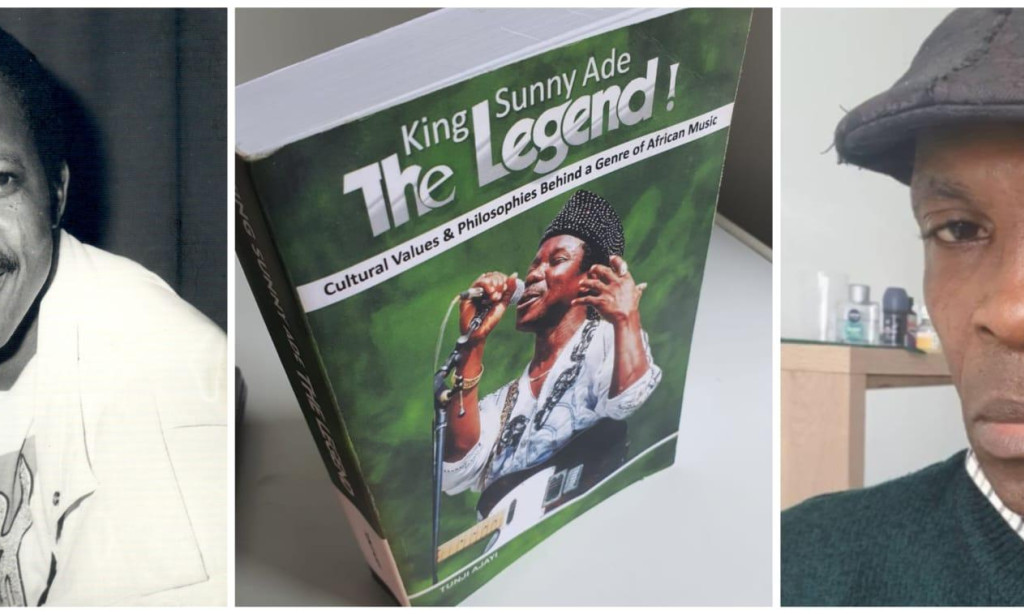
**Please BUY the Book> KING SUNNY ADE THE LEGEND: Cultural Values & Philosophies Behind a Genre of African Music via Amazon.
Attestations
“King Sunny Ade the Legend” written by Tunji Ajayi, provides the reader with a comprehensive account of the life and experiences of a musical titan. Epic and sweeping in nature, the work reveals much of Mr. Ade’s unique background and the enormous influences in his life. In addition, the author relates many unknown facts and stories regarding his life and how his music impacted others. Refusing to be stereotyped or pigeon holed, Mr. Ade managed to conquer a variety of musical realms demonstrating his extraordinary talent and superb dedication to his craft. While thorough and detailed in nature, the submission does not overwhelm the reader with unnecessary information. The work is balanced in terms of displaying numerous aspects of Mr. Ade’s life. Relying upon a myriad of sources, Mr. Ajayi presents a well rounded biography which could resonate strongly with those who share his appreciation for this most talented individual.
Composed primarily in a captivating narrative, the work flows at a brisk tempo, which should maintain the reader’s interest throughout. The author’s admiration for Mr. Ade is apparent from the initial pages of his submission, but it does not preclude him from delivering an even-handed account of his life. Conversational in tone and significant in content, the work could very well be regarded a valuable resource for those seeking to learn more about this major musical talent. Tunji Ajayi’s highly descriptive style of writing combined with a keen sense of detail could further enhance the appeal of this work. (Kristen Burns, Dorrance Publishers, Pittsburgh, USA)
<><><><><><><><><><><><><><>
“I learnt quite a bit from my review of KSA The Legend! I really enjoyed his approach in presenting the material and outlook on the subject.. Tunji Ajayi has a nice way with words and his writing has a nice flow to it. The book is nicely put together and filled with information I am sure that people will find fascinating.” (Lisa Colello Conner, Outskirts Press, Colorado, USA)
*’Tunji Ajayi, a creative writer, author, biographer and documentary producer writes this piece from England. (+2348033203115; +2349020007004)
Kindly SHARE this post. >BUY copies for your library and as gifts to friends.
Please use the link to buy directly from:
1. Amazon: https://www.amazon.com/dp/B09FSCJX78/ref=cm_sw_r_awdo_navT_g_J0VCDAW1Q397H38C2QXF
OR Author’s Linktree: https://linktr.ee/TunjiAjayi?fbclid%3

You must be logged in to post a comment.