
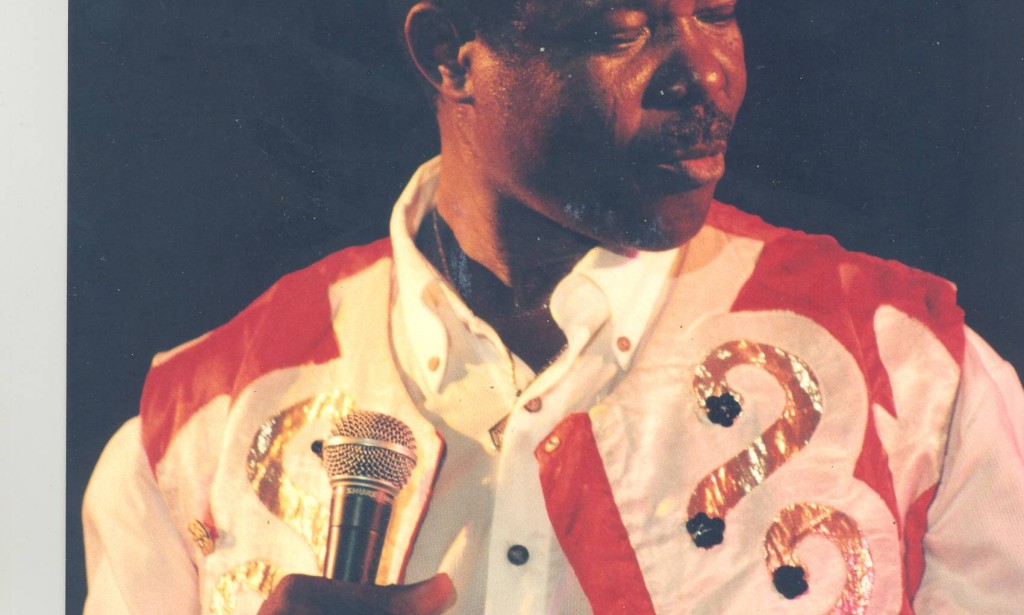
THE ALLEGORY - HYPNOSIS 5:
ESSAYS ON THE MYSTIQUE OF KSA THE SAGE
by Tunji Ajayi
Prologue to Hypnosis 5: In creative writing, allegory is often used as a symbolic representation of something, viz: an idea, practices, societal foibles, idiosyncrasies etc., by a character. That character reveals hidden facts, or meaning of what he represents, apparently to teach some moral lessons. The preliminary chapter of King Suny Ade The Legend!, entitled “The Hypnosis” shows the hypnotic effects, id.est charming effect or dazzling effect of King Sunny Ade’s music on this writer from his youthful days. We recall that James Morton averred in his Hymn to Harmony that “Music with its sudden charms can bind wandering sense and calm troubled mind.” Thus, it has therapeutic value. That aptly explains the power of good music on the audience’s sensory nerves.
Perhaps, this writer’s personal experience largely depicts the magnetic effect which KSA’s music has on millions of listeners the world over. In his poem, “As a man Thinketh” the writer and philosopher James Allen seems to be saying; albeit impliedly, that a man’s intention or thought is as good or as bad as his action. Thus, a man is literally what he thinks. And what he thinks is a reflection of what he feeds his often impressionable mind. Any lesson here? This logical deduction is the more reason why relaying only meaningful, healthful and didactic music should be encouraged in our media space, and embraced by our modern-day practitioners. It impacts on the lives of both the youths and the adults alike. Show me your youths of today, and I tell you your nation’s future.
Lewd lyrics and obscene messages pervert the minds and promote moral turpitude and character debauchery. Only good and meaningful music remains evergreen. “Sunny Ade’s mind blower: Sheindemi/Ile Labo Sinmi Oko” - (LPAS 8007, Vol. 2); the epic album “Syncro System” - (AS2-L, Vol 12); the master blaster: “Afai Ba Won Ja” - (AS1-L Vol 7) etc. were released in the early ‘70s, i.e. about 48 years ago! Yet, listening to the lyrics today is heartwarming! The messages remain apropos, and the evocative sound is still enjoyable. The messages never sound hackneyed.
>>>Please enjoy this week’s portion of The Hypnosis 5 and the Allegory: >>>
Analyzing King Sunny Ade's voluminous works in a single book volume is like untying two Gordian knots at the same time. Close observers of this strange man and his works of almost five decades now will simply agree with this assertion.
KSA is a very versatile artiste. His musical artworks are extremely complex. They are even far ahead of this musical age. This man, whose brilliance and esoteric feats have dazzled the world for almost five decades now possesses chameleonic image which sextuples as a musician, a comedian, a film actor, a dancer, a poet and a philosopher. Hence, I honestly feel it will amount to gross underestimation of his sterling worth and incalculable error on my part to see him only in the light of a musician, and conclude that a single book volume will be a conclusive exposé on his art life.
Indeed, when a few years back, the privilege of writing a brief analysis of KSA's phenomenon in his autobiography, Hooked to Music was extended to me, I found it an extremely difficult task to perform, mainly because KSA is extraordinarily prolific and overflowing with traits that can hardly be explained "in brief." Nonetheless, I had to "squeeze" in words to do the analysis as compendious as practicable then.
Now this book avails me the unique opportunity of writing in details about this Titan and his escapades in the world of entertainment. However, I am doubly sure that reading about the man, who has ceaselessly eased our pains with his soothing and philosophical music for many years, whenever the tide of times put us under stress and strain, will be an exhilarating effort.
But legal luminaries always assert: Nemo dat quod non habeat- “You cannot give away that which does not belong to you.” Yes. In the same vein, no man ever pontificates successfully on the subject on which he is a novice. Doing so is tantamount to presumptuousness. What then qualifies me to write on this world-renowned icon of music? Perhaps this story would tell.
The reminiscences of my boyhood days are resplendent with passions, adventures and escapades. I should confess that I did not open my youthful and feeble mind to anything scholastic other than playing football, listening to, and analyzing Sunny Ade's music. I remember that during my secondary school days in the early 70's, I spent most of the evening hours at the roadsides, listening to the high-pitch tone speakers of the roadside record sellers, blaring to the high heavens the melodious lyrics of Sunny Ade's “Synchro System”, “E ki'lo f'omo ode”, “ Ogidan o ni se barber”, “Sunny ti de” etc. The costliest mistake Mama made shortly before our resumption from a third term holiday in 1975 was her giving me a large sum of money to purchase all the books I needed for the beginning of that new academic session. On the way to the bookshop, something within me told me I needed no books at all for the session! Rather than wait endlessly every time beside the heavy-traffic road, listening to Sunny Ade's music, I reasoned, I should ‘wisely’ spend the money on a portable cassette player and henceforth enjoy Sunny Ade's music unhindered within the confine of my solitary room.
Eureka - I found a good idea. I did just exactly so. I purchased the cassette-player. Hmm. That was my own ‘books’! The bulging ‘books’ for the new session was stealthily concealed inside a big opaque polythene bag.
I returned home, and without bothering to open the bag, I dangled to mummy's unsuspecting sight the ‘books’; brought ‘them’ into my room, and the era of unrestrained enjoyment started. Thereafter, every young girl in our school knew me, as I would tilt my left shoulder up at a convenient angle, walking stylishly about the school premises with my much-cherished mobile cassette-player, oozing out Sunny Ade's “Synchro System” melodies, and the syncopating beats of “Sunny ti de”. However, my ‘unfair’ teacher would not accept me into his classroom unless I presented my books. I reasoned I should not be a slave to my teacher's wish. I needed to live in a world of my own. I never bothered about his harsh and peremptory demand, as I had an alternative ‘classroom’. Thus, I would climb a tree in the school premises to enjoy Sunny Ade's captivating lyrics while my classmates were pursuing their academic studies.
I almost froze on the day my teacher came to our house to report me to mummy that I had no single book! The enraged woman snapped, wielding her rod of discipline, and fully poised to spank the devil out of me: "Where are your books which you purchased the other day!?” She fumed. "It is . . . it is . . . it is . . ." I stammered endlessly, unable to provide a reasonable excuse.
I watched nonplused as Mummy and the teacher rummaged my small room and saw the cassette player that had made a truant of me throughout the academic term. The disciplinarian mother who seized my beloved property subsequently whipped the devil out of me with her rod. But to my chagrin, mummy too soon became hypnotized to the pulsating rhythms of “Synchro System”, and would hardly sleep in the night without playing the music. Having played several pranks aimed at retrieving my cassette-player from the Synchro-system-infected mother and failed, I accepted the battle as a lost one.
I remember very clearly that in 1975 shortly after Sunny Ade's return from America, news filtered into my ears that the icon, who has been off the entertainment podium for about one year, would perform live at the Osogbo Sports Club. My younger brother and I spent two days planning and perfecting how we would secretly leave home in the frosty night, to watch the maverick artiste live. On that memorable night, having made sure the tough mother had slept off, my brother and I tiptoed like a cat after its prey; carefully opened the exit door and bolted out into the eerie night. We made our way to the Osogbo Sports Club to watch Sunny Ade's live performance.
The music star, with wailing siren heralding his kingly arrival in a convoy of cars, was entering the venue when suddenly the crowd surged forward to catch a glimpse of the controversial star . . .
(Oh!, . . . what really happened next? A disaster? . . . A convivial atmosphere? Kindly join me on this page next week on “Hypnosis 6”, Deo volentim.

You must be logged in to post a comment.